A different domain from everything else on this site. The same instinct.
Most of what I publish is technical: a framework, a protocol, a learning initiative, a companion. This one is not. It is the other thread, the one that has been running underneath the technical work for more than twenty years, and it has never been told in one place.
It was an epic failure. It never got rolling. I want to tell it properly anyway, because the shapes in it are the shapes in everything I am building now, and you cannot see that without the story.
The man in the mud
On 26 December 2004 an earthquake off Sumatra sent a tsunami across the Indian Ocean. It killed about 230,000 people in fourteen countries.
Some time after, I saw a photograph of a man standing in a field of mud with his arm buried to the shoulder, feeling for cans of food. He had lost his wife and his seven children.
That was the end of it being about me.
What I could do about it was the thing I knew how to do, which was gather information and put it in front of people. So I built AllCharities.org: a web application that gathered third-party reporting on what charities were actually doing on the ground, so that someone deciding where to give could decide on evidence instead of on advertising.
Choosing a charity, then, was a phone call to a friend. GiveWell would not exist for another three years. Routing giving through evidence rather than brand recognition was not yet an idea anyone I knew was working on.
AllCharities.org had the evidence. It had no reach. Hold on to that sentence; it is the whole of the next twenty years in eight words.
The bundle
In 2011 the rains failed across the Horn of Africa, and on 20 July the United Nations declared famine in parts of southern Somalia. A later study put the number of dead at around 258,000, about half of them children under five.
I saw it on television. The report told the story: a father and a mother who had walked for a week through the drought to reach a hospital with their baby. Then one shot of the two of them. A glancing shot. They did not speak. It was just the look on their faces, the father, the mother, and right beside them a little bundle.
The baby had died.
The look on their faces is what stayed.
I want to be careful here, because memory is not a record. I am fairly sure that picture is where 1Click1Life came from. I am not completely sure. What I am sure of is that it was one of the things that made me get on with it, and my own notes from June 2012 put the start in the same place: “I started thinking about this when I saw the famine in Somalia last year.”
For a long time after that I had a picture of Somalia on my Facebook account. Not the flag; a picture of Somalia. People did not understand why it was there. This is why.
Tuning it out
The thing I noticed next was not the famine. It was a lot of the people around me looking away from it.
Not out of cruelty. Out of fatigue. The same notes, in my own spelling and punctuation:
I noticed that a lot of people were just apathetic … They were just tired of bad news… and they were tired of seeing all the bad images on TV…and a lot of them just tuned it out.
The pictures came every night, and people had stopped being able to look.
So I asked a different question. Not how to make people feel more. How to give them something to do.
So I needed to come up with a way of informing people so that they can take action. But I had [to] make it fun.
Fun was not the opposite of taking it seriously. Fun was the delivery mechanism for the seriousness, aimed at the people who had already stopped watching the news.
One click, one life
What if with just one click, you could save one life?
That was the pitch, and the mechanism behind it was to be a treasure hunt.
One click, a follow, would sign you up. From then on, each post you saw would carry a clue to real buried treasure, put up by businesses, and alongside every clue a short message about what was happening in Somalia and what you could do about it. Solve the riddles, work it out with your friends, get there first, and the treasure is yours.
The charities the site pointed at for Somalia were established ones already working there: Action Against Hunger, Oxfam, the Red Cross. Donations were to be made on their own pages; 1Click1Life would never accept one. From the 2012 notes, capitals and all:
We need to make sure that we are upfront with our motives… that all of this is to promote and bring awareness to causes and at NO TIMES DO WE TAKE MONEY. All the money that is donated by businesses must be posted up on the web page.
The measure of success was written down too: “if we can get people to donate $1000 for every $100 prize then we would have done our job.” And so was the long game: that when the next disaster hit, there would already be a large community of people who had played before, and a treasure hunt would get a response.
The idea was that hitting follow was saving a life. Not as a slogan. As a chain: the click gets you the clue, the clue comes with the cause, the cause comes with a way to act.
Corporate social synergy
The principle underneath it had a name.
Corporate social synergy stipulates that social organizations, corporations, the community and the media all work in a synergistic fashion to bring awareness to social causes.
That is the definition as I gave it on video in 2021. In 2016 it had three parties, a win-win-win between corporations, social organisations and the community. By 2021 the media was in it too, and the intro video ended its list with and you.
The difference from corporate social responsibility was deliberate. Corporate social responsibility usually means a company doing something good that also, directly, saves it or makes it money. Corporate social synergy cut that link on purpose. A company would promote a cause with no direct connection to its own business, and get back what a company actually wants from that: attention, recognition, and over time loyalty.
Every party was meant to win something:
- Charities: awareness for their cause, and traffic to their own pages.
- Businesses: followers, recognition, and their name next to a cause.
- The community: something real to learn, in a game, with a real chance of winning.
- The media: content worth running.
And every party had responsibilities. This is the part I would underline if I could only underline one thing. Charities had to educate the public and give it a way to act. Businesses had to fund the campaign, promote it, and commit in writing, a contract publicly viewable on the site, to putting part of their marketing budget behind a cause every month. The community had to learn, act where it could, and, all things being equal, reward with its purchasing power the businesses that took part. And 1Click1Life’s own job was to coordinate the campaign and maintain its integrity: to be the party in the middle that made sure everyone else lived up to what they had signed up for, and enforced it where it could.
The win-win part I said on video in plain words:
It’s our tendency to kind of think that if somebody wins somebody must lose… and quite frankly that’s outdated.
The plan for Mississauga
By 2016 there was a first campaign on paper, in Mississauga.
Real gold rings, a hundred dollars each, buried around Mississauga. Clues given out on Twitter and Facebook. The final clue always given out on the charity’s own account. Every clue carrying a piece of information on how to fight hunger in the city.
The cause was hunger, and the first charity was a local food bank; the plan said why in one line: since the famine in Somalia that spawned 1Click1Life. A local taxi company, a sponsor in the plan, was going to tell its customers that its fleet, three hundred cars, now took food donations, and drop them at the food bank every week. The plan counted three thousand calls a day and call-takers who spent half their time waiting for the phone, and had them talking to the community between calls. Business money was going to go through a public crowdfunding page, so that 1Click1Life never touched a dollar and anyone could see every one.
Six people had committed to helping. The front end and back end of the application had already been built, three years earlier. And I was out picking up garbage in my own neighbourhood and putting up 1Click1Life signs. The plan invited anybody who wanted to, to do exactly the same: a ribbon, a sticker, and their own street.
It was also in the business plan of the company I run now. Obsidian Delta’s plan, from 2016 through 2021, said in writing that sponsoring 1Click1Life was how we would become known in Mississauga, and its longest-range section said it was “imperative that Obsidian Delta focus on the 1Click1Life initiative.” On paper, the technical company and the charitable game were one plan.
The walk home
The plan had me putting ribbons on trees and posters up around Mississauga, as hints. Which meant I was going to be making a mess of the place, so I decided to compensate for it. I did not have a car then, and the walk home from work took about an hour. So on the way home, I would pick up garbage.
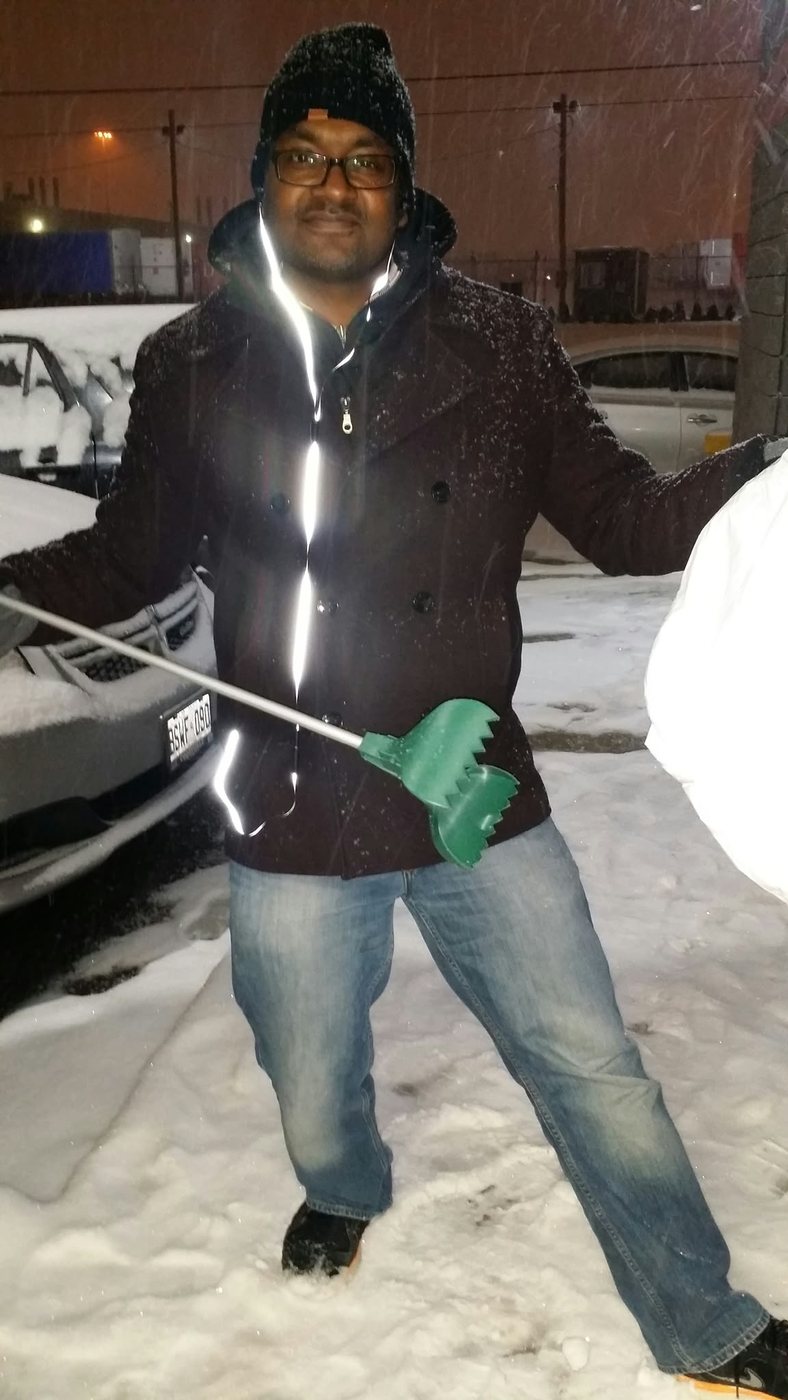
The evening this was taken, the snow was starting as I got ready to leave, and the storm hit properly while I was walking. By the end there was a serious amount of it on the ground. I was going to do it no matter what, so I did it in that.
There were not many people out. I remember two guys in a car, maybe ten years younger than me, who caught sight of a man in a pea coat with a litter picker in a snowstorm, and the look on their faces said what the fuck. I looked back and smiled.
Five minutes from home, I pointed the phone at myself. I did not have anything profound to say, and I said so. What I said instead was the whole of it: you got to do what’s got to be done.
That is the point, and here it is again, less politely. I do not give a fuck. If a cause is just, if there is meaning behind what I am doing and I can see it, I really do not care what anybody else takes it as. It is bigger than me. You got to do what’s got to be done.
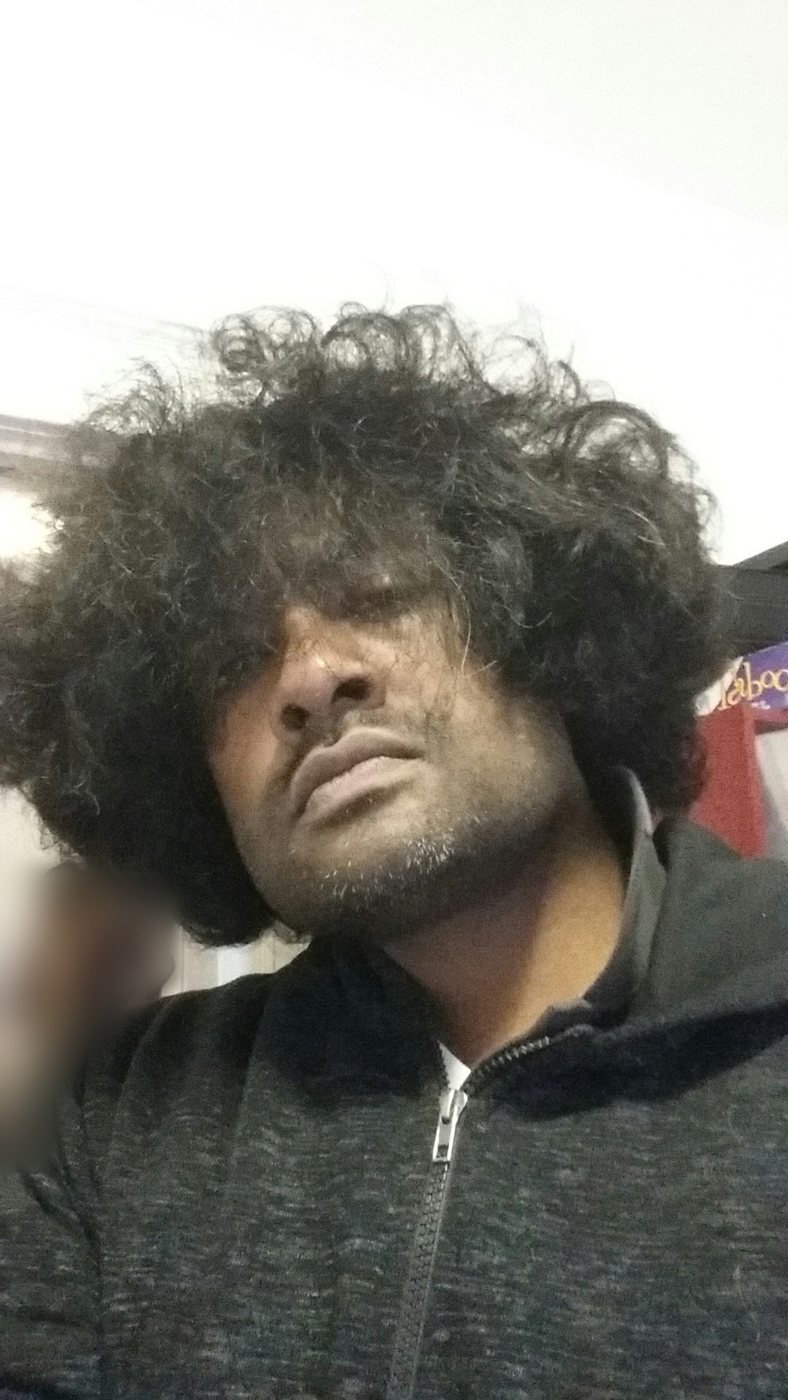
An aside, because I found it while looking for these pictures. This was my hair in the same period. Real, and no conditioner.
AllCharities.org, the second time
In August 2021 I tried again, out loud.
Over six days I put up eleven short videos on two YouTube channels, one for 1Click1Life and one for AllCharities.org, explaining corporate social synergy, the benefits for each party, the responsibilities of each party, and how the two sites worked together. They are all still up.
In 2021, AllCharities.org was 1Click1Life’s sister site: a central place where charities could be promoted on social media, and the place where every clue lived. And the clue was locked.
To unlock it, you had to leave. You went to the charity’s own website, found out what they were doing right now, came back, and typed the answer in. In the demo I recorded, the sample post used World Vision Canada as its example, and the question was which country they were helping. The answer was on their front page: Haiti, after the earthquake. Type it in, and the clue appeared: We the North. The treasure in the demo was valued at five hundred dollars.

Businesses would not have to build anything. They would follow AllCharities.org, and when a clue went out, repost it to their own followers. Their feed would become part of the game. In my own words from the time, the honest version of the pitch to a business: you don’t want to say follow us so that we can sell you things… you do want to just be honest and tell them follow us… where we’re giving clues to real buried treasure.
Learning was the price of the clue. You could not get to the treasure without visiting the people doing the work and understanding one true thing about what they were doing.
That same month, August 2021, I started building the personal agent that became my cognitive companion.
An epic failure
It never got rolling.
I can tell you the shape of it, as I see it now. AllCharities.org had the evidence and no reach. 1Click1Life was built for reach, around a narrower point. Both halves were necessary and I could only ever get one of them working at a time.
And a synergy is a strange thing to try to start. It is a claim that everybody wins when everybody shows up, and until everybody shows up it is a pitch.
There were outside things too. It was around the same time I was trying to get Obsidian Delta up and running, and I was trying to bundle all of it together, and my attention went where it had to go, because to survive I needed money. Same old story. Maybe it was too many new concepts at once. At the time I did not know. The truth is I still do not know. There were a lot of things.
By January 2024 both were over.
My headline on LinkedIn says if you’re not failing at something, you are not succeeding. This was failing, properly.
But read it the way I read everything I have built: as a peg. A peg is not a claim that it was right. It is what let me reach the next thing.
The same shapes, in a different domain
This is why I am telling the story now.
Nothing in this post is technical. It is about charities, taxis, riddles and gold rings. But lay what I was trying to build in 2011 next to what I am building in 2026, and the shapes line up almost one for one.

Separate parties, declared responsibilities, and a party in the middle that holds the integrity. That was corporate social synergy, with 1Click1Life in the middle. It is now the Constraint Protocol: people, companies or software declare in advance what they will not do, and their conduct can be checked against it by anyone who cares to check. And it is the reason the DAX Foundation exists apart from Obsidian Delta. A company can commit to a constraint. It should not also be the one that holds it. In 2016, 1Click1Life was to be the not-for-profit in the middle and Obsidian Delta one of its sponsors. The roles were already there.
The money posted publicly. Upfront with our motives. That was 2012, in capitals. It is now the record that cannot be quietly edited, and it is how I publish: every change visible, the earlier wording kept.
Nobody has to lose. That was the win-win-win. It is now what the protocol is meant to do beyond keeping a record: let knowledge and reasoning compound across parties instead of resetting every time two of them meet.
The clue behind the charity’s own page. That was learning as the way in, not the lecture at the door. It is now Meta DAX: learning for every human being, where what is offered is always a way and never the way. In one of the 2021 videos I said it directly:
If you know anything about me, I’m all about trying to bring the right information to the right people at the right time. And in my other work, that’s my primary focus.
In my other work. Even then there were two threads, and I was describing both of them with the same sentence.
Apathy, answered with something to do. That is the deepest one. The famine pictures did not fail because people did not care. As I saw it then, they failed because caring with nowhere to go turns into looking away. 1Click1Life was an attempt to give a person something to do with what they had just learned. That question, what a person brings and what they do with what they are given, is now human delta value, which is close to the point of everything I am doing: the reason to take cognitive labour off a person is what they do with the cognition they get back.
Synergy. I used the word then to mean that every party gets more together than alone. I use the same idea now for a person and their companion: one unit, more together than either alone, and only as strong as the human bringing their best.
One click, one life. The constraint everything now sits under is DAX: the preservation and expansion of life, humanity, and consciousness. Life is the first word.
The domain changed. The instinct did not.
Have fun saving the world
Nearly every one of those videos ends the same way. I said it a little awkwardly, to a camera against a black background, and I meant it every time: have fun saving the world.
The treasure hunt never got rolling. The instinct never stopped. The man in the mud and the parents with the bundle are where it started. And the part of me that wanted to bury gold rings around Mississauga so a stranger would learn one true thing about hunger, and walked home through a snowstorm picking up garbage to make up for the ribbons, is the same part that is building the rest of this, with better tools.
The record
- The 1Click1Life videos, August 2021: youtube.com/@1click1life32, starting with What is Corporate Social Synergy? and the 75-second Quick Intro. Four of them are embedded above.
- AllCharities.org: the two sites, and how they fit together, and the demo, clue and all.
- The working history, with dates: LinkedIn.
- Quoted here from my own files: the June 2012 working notes on 1Click1Life, the 2016 write-up of corporate social synergy, and Obsidian Delta’s business plan, 2016 to 2021.
- The famine figures are from the 2013 study by FAO’s Food Security and Nutrition Analysis Unit for Somalia and FEWS NET; the tsunami figure is the commonly cited toll.
This post is versioned like everything else here. It will be revised, the dates at the top will say when, and the earlier wording will be in the History.