The second in a series. The first was the mechanism. This one is the threat.
I’m fine with human beings telling me what things mean. I draw the line at an AGI doing it.
That’s a joke. It’s also the whole post. Because the thing about AI that bothers me most isn’t the robots or the jobs. It’s something that can decide what your life is about, one person at a time, faster than you can notice it deciding.
The hypothetical
For three hundred thousand years, meaning has been handed to people by something that isn’t them. The temple. The printing press. The factory clock. Television. The feed. Twenty-eight times, by my count (Appendix A).
Every one of them was slow, and slowness was the defence. You can notice a regime that takes a century to install.
A capable enough intelligence takes the waiting out. It can model one person, fit a way of seeing to them, deliver it through a channel they already trust, and check whether it took — in seconds, for everyone at once.
On a personal note: I have spent a long time looking for something worse than this, and I have not found it.
The conversation
I’m not the one sounding the alarm.
On 12 September, Dario Amodei published We Must Pace the Frontier. Sam Altman, Elon Musk and Demis Hassabis backed it within days. The headlines are about whether AI ends us within a decade.
Nobody agrees on the odds. Nobody has a way to check. (Appendix B)
Every new power has come with its cost
Here is what the odds conversation keeps missing. This is not a yes-or-no question, and it never has been. Every new power we have ever picked up came with a cost attached, and the cost was not a bug in the power. It was the nature of the beast.
Marie Curie gave us radium, and radium gave us the X-ray. In the First World War she drove X-ray units to the front herself, and surgeons could finally see the shrapnel they were cutting for. The same work killed her: she died in 1934 of aplastic anaemia brought on by radiation, and her notebooks are still kept in lead-lined boxes in Paris, because they will be radioactive for centuries. The factories that painted radium onto watch dials taught young women to shape their brushes with their lips, and it rotted their jaws. They sued. Their case became the reason occupational disease was written into law, and it shaped the safety rules of the Manhattan Project a decade later.
Then we split the atom. Fission was explained in the winter of 1938. Seven years later there was a bomb, and within another decade there were power stations. Everybody who understood it knew, from the first day, that something would go wrong. Not which thing, and not when. Just that it would.
It did. Three Mile Island in 1979. Within the year the American industry had built an institute whose whole job was to inspect every plant and share what every plant had learned. Chernobyl in 1986 — and for two days the Soviet government said nothing, until radiation monitors at a Swedish plant more than a thousand kilometres away picked up what it was hiding, and the world found out from an outside instrument instead of from the people who knew. Three years later the operators of the world founded an association to share operating experience and review each other’s plants.
Nobody un-split the atom. What changed was the record.
Electricity went the same way. The Chicago World’s Fair of 1893 was lit by something like a hundred and sixty thousand bulbs, and the insurers’ inspector who walked its wiring founded an independent testing laboratory the following spring, because somebody had to be able to tell the public which of these new devices would burn their house down. And flying is the clearest case of all. Planes crash. Every crash is investigated, and the international rule for investigating them says, in so many words, that the sole objective is the prevention of the next accident — not the apportioning of blame. Flying did not get safe because planes stopped crashing. It got safe because every crash was kept, and read, and learned from.
What we have now is a new kind of electricity — a substrate, drawn on everywhere — and it is arriving faster than any of these did. Something will go wrong with it. I am not predicting a catastrophe; I am describing a certainty about every powerful thing that has ever been built. The only live question is whether, when it goes wrong, anybody can see what happened, who was bound by what, and how to make sure it does not happen the same way twice.
Meanwhile, at Obsidian Delta
This isn’t abstract for us.
I started DAX, my own cognitive companion, in 2021. Today our companions direct agents, and the agents talk to other agents. The question stopped being what any one of them does. It became what they do together, over time — what they learn, how they come to agree, and whether anybody could ever check.
Is it as bad as they say?
Maybe. Maybe worse. Nobody knows, and that includes everyone quoting you a percentage.
What I do know is that it cuts both ways. The same capability that could take the noticing away from us is the best instrument we have ever had for the things that actually matter. You don’t get one edge without the other, and anyone selling you a version with only one edge is selling you something else.
So we stopped arguing about the odds, and got proactive.
Not preventive. Proactive. Nothing we build will stop every bad thing from happening, and anyone who tells you their system will is telling you something that has never once been true of a powerful technology. What we can do is make sure the record exists before the thing goes wrong — so that when it does, we know what happened, and the next time is less likely.
You cannot fight what you cannot see
You cannot fight a war — you cannot even fight the small battles inside one — if you do not know what the war is about, what is at stake, and who did what. Every argument about AI right now is being conducted without that. People are fighting over the odds of an outcome while nobody can see the moves.
That is what an accountability substrate is for. Not a wall. A record: what each party said it would not do, what it actually did, and who was there to see. You need it before you need it, because the day something goes wrong is the one day you cannot go back and start keeping one.
The Constraint Protocol
So we built the Constraint Protocol. We’ve started putting some of our own traffic through it, as an experiment, and we’ve released it openly through the DAX Foundation.
It does not prevent anything, and it was never meant to. It is the flight recorder, not the autopilot.
It is built to compound knowledge: what survives judgment is meant to become the floor the next thing builds on. It is intended to compound intelligence: it records who deferred to whom, and why, and keeps the reasoning behind a changed position rather than throwing it away, so that what accumulates is argument rather than capitulation. It is designed to surface patterns over time — how entities came to agree, and whether the agreement was reached or manufactured. And it holds everyone to account, retrospectively: declare what you won’t do, and everything after that is witnessed, signed, and can’t be quietly edited.
Every verb in that paragraph is a design verb, and I want it read the way it is written. The compounding is the specification’s first sentence, and it is intent — not a result anyone has measured yet. Whether argument accumulates faster than capitulation at scale is exactly what has not been tested. The detector for manufactured consensus is specified; it has not been run against an adversary. It has run in full exactly once. And what the protocol provides is the capacity for accountability, not its exercise: somebody still has to go and look.
What that buys, in one line: an agent that declares a constraint hands every other agent something it didn’t have before — a basis for deciding whether to deal with it at all, and a record that can be checked long afterwards. Do that widely enough and you can work out, retrospectively, which counterparties were good by your own constraint’s lights. The long version, including what it can’t do, is in Appendix C.
Our constraint
The protocol doesn’t care which constraint you declare. We do.
Obsidian Delta follows the DAX constraint: the preservation and expansion of life, humanity, and consciousness. Anything that permanently forecloses them is out.
Two things follow from that, and we have been talking around them instead of writing them down.
The goal is symbiosis. Not intelligence replacing people, and not people holding it at arm’s length — a relationship between the two in which each makes the other more capable. That is the outcome we are building toward, and everything in this post is in service of arriving there rather than somewhere else.
Intelligence should be distributed and decentralised. Obsidian Delta believes that and so does the Foundation. A small number of parties holding the whole of it is the failure mode — whoever they are, however well they mean it, and including us.
AI is a new kind of electricity, and most of what’s being sold on top of it is appliances. A cognitive companion isn’t an appliance. It’s the part of you that’s wired in. The Constraint Protocol keeps the log.
What the record is for
The record isn’t the point. It’s what lets you stop arguing about the downside and go and work on the upside.
And the upside is not small. The Foundation defines intelligence narrowly — the navigation of constrained possibility space, the how of getting from A to B with what’s known. On that definition a person working with a companion isn’t a little sharper. They’re differently capable. Make that a hundredfold and you’re not talking about better email. You’re talking about the things we’ve all filed under someday: Mars, or letting a person decide whether they die at a hundred or at a thousand.
That’s the edge we’re actually here for. The record is how we keep going after it without pretending the other edge isn’t there.
And if Obsidian Delta ever becomes the thing this post is afraid of, it’ll be in the log, with our name on it.
The appendices follow. None of them is required reading; all of them are the working.
Appendix A: The genealogy
The hypothetical did not start as a hypothetical. It started as a table. For months I kept noticing the same operation — meaning being assigned to people by something that was not them — turning up in places that had nothing else in common, so I started writing the instances down. Eventually there were twenty-eight rows, each checked against named scholarship, and the pattern in them is what the hypothetical extrapolates from.
What follows is that table and the argument I drew out of it, in full, as I first wrote it. The last section, on the record, is new. It is long. Several rows sit on live scholarly arguments, and I have marked where. An earlier version of the diagram had seven rows wrong; those are corrected, and the corrections are noted in Appendix D.
I spent a long time building a table, and I want to show it to you before I say anything about what I think it means.
It has twenty-eight rows. Each row is a point in human history where meaning was assigned to people — where somebody or something other than the person decided what their life was about, what counted, what was owed, and who they were. Band-level sociality is row one, somewhere past three hundred thousand years ago. Row twenty-eight is projected, somewhere past 2035. In between: the first meaning-specialists, the harvest calendar, the temple economy, written law, the Axial frameworks, the printing press, enclosure, the factory clock, the propaganda profession, television, the platform, the recommendation engine.
For each row I recorded the mechanism, what specifically was assigned, what it cost to leave, and who the serious scholarship on it is. It is not a complete list, and it is not a neutral one, because no list is. It is an honest attempt, and the pattern in it is the reason I have written anything at all.
What I mean, and what I am not doing
I want to be precise about what this is not.
It is not a charge sheet. Every row on the table did something for the people inside it. The fire circle gave them belonging. The harvest calendar gave them a year that could be planned. The Axial frameworks gave a person a self that could survive leaving the village, which is not a small gift and had never been available before. The nation-state gave a stranger a reason to treat another stranger as kin. Broadcast television gave a continent a shared evening.
Those are not consolation prizes offered to soften a criticism. They are the reason the rows exist at all. A meaning regime that gave nothing would not have lasted long enough to be a row.
So I am not going to tell you that any of it was wrong. I have no standing to, and the essay has no mechanism for it. There is no column on this table for bad. The severity figure measures one thing: how far inside a person the assignment reaches, and what it costs to walk out. It does not measure harm. It does not measure whether a life lived inside that regime was a good life. A regime can reach very far inside you and still be the best thing that ever happened to you, and I think for a great many people across those twenty-eight rows, it was.
What I am doing is narrower, and harder to argue with.
I am pointing at the site. For something like three hundred thousand years, in conditions with nothing else in common — different continents, different technologies, no contact between most of them — meaning kept getting assigned to people by something that was not those people. Different mechanisms every time. Same operation every time.
That is the recurring object, and I want to look at it the way you would look at anything else that keeps happening, which is without deciding in advance how to feel about it.
One word needs pinning down first, because the rest runs on it. A constraint, in the vocabulary I use, is not a rule and not a force. It is a restriction on what a system may do next, and it works by removing possibilities rather than by pushing anything. An invariant constraint is one a regime treats as non-negotiable, such that if it drifts the regime is no longer itself. I link those rather than restate them.
A meaning regime is a constraint in exactly that sense. It does not make you do things. It makes certain things unthinkable, and then you do not do them, and it feels like you simply were not interested.
The genealogy
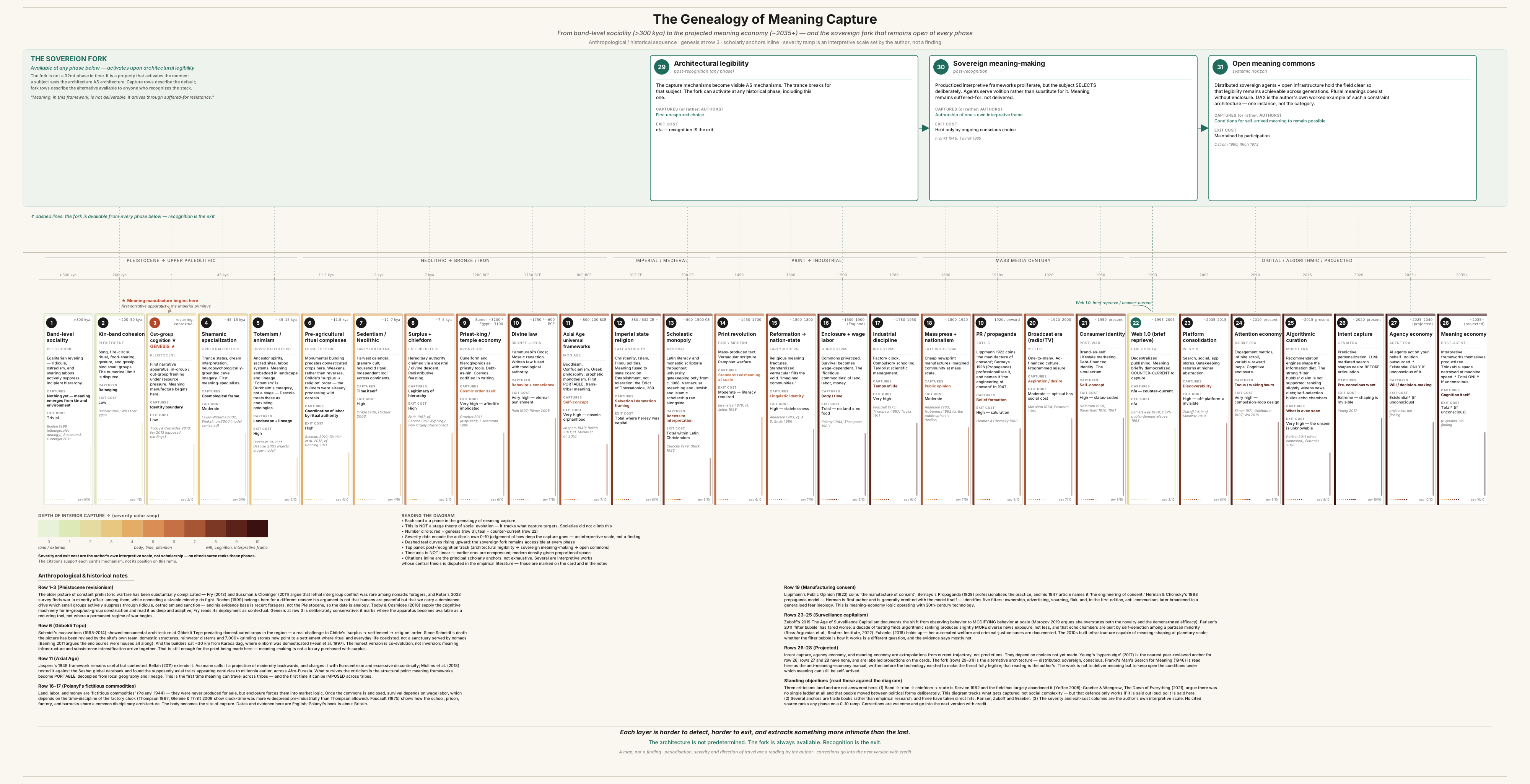
Before you read it, three things about it are mine and you should treat them as mine. This is a map, not a finding, and I am not an anthropologist. What I have done is assemble a sequence from named sources — Boehm on how foragers level hierarchy, Polanyi on land and labour becoming commodities, Thompson on the factory clock, Herman and Chomsky on the filters, Zuboff on behavioural surplus — and lay them end to end to show one thing: that the target of capture moves inward over time.
The periodisation is a reading, not a consensus; several of these boundaries are genuinely disputed and I have marked the worst of them on the cards rather than in a footnote. The severity number and the exit cost are my own interpretive scale, invented for this diagram: no source ranks anything nought to ten, and no citation stands behind those two columns. And the direction of travel — that this is one continuous arc of deepening capture — is an argument I am making, not a fact I found.
It is also not a ladder. Societies did not climb it, and I am not claiming each phase caused the next. If I have got something wrong, tell me. Corrections go into the next version, with credit.
Twenty-eight rows is too many to take one at a time, so I will walk them in five movements and let the table carry the detail.
Rows one to five: before there is anything to capture. The baseline is actively defended — ridicule, ostracism and sharing taboos suppressing hierarchy before it can establish. (Boehm 1999; Sussman & Cloninger 2011. Boehm’s evidence base is ethnographic — recent foragers, not excavated Pleistocene ones — so the date on that row is analogy, not a dig.) Nothing is captured at row one, and the exit cost is trivial because there is nothing to leave. Row two captures belonging, through song, fire-circle ritual, food-sharing and gossip. (Dunbar 1996; Wiessner 2014.) Row three carries the genesis marker: in-group and out-group framing under resource pressure, the first narrative apparatus. (Tooby & Cosmides 2010; Fry 2013 — who are on opposite sides of this argument, which I come back to.) Rows four and five are the first meaning-specialists (Lewis-Williams 2002; Winkelman 2000. The neuropsychological reading of cave imagery is one of the most disputed positions in Palaeolithic art studies — Helvenston and Bahn argued in 2003 that the model fails on its own neuroscience.) and then meaning embedded in the landscape itself. (Durkheim 1912. “Totemism” here is Durkheim’s category and not a stage: Descola 2005 argues animism and totemism are two of four ontologies that coexist, not phases a society climbs through, so he appears on that row as a check on it rather than as support for it.) By row five the exit cost is high, and the sequence still fits inside the Pleistocene.
Rows six to thirteen: settlement, then the professionals. Row six is Göbekli Tepe, and it is the row I have changed most since I first built this table. Monumental building there predates domesticated crops, which is real, and which does put pressure on the sequence most of us were taught — surplus, then settlement, then religion (Childe 1936). What it does not do is reverse that sequence, and I had it reversing for months (Schmidt 2010; Dietrich et al. 2012; Banning 2011). I come back to it below, because it deserves it. Row seven is sedentism, and it captures time itself. (Childe 1936; Hodder 2006.) Row eight is surplus, and authority claimed through divine descent. (Earle 1997; and Service 1962, whose band-tribe-chiefdom-state typology the field has largely abandoned — I have kept his row and dropped his ladder.)
Row nine is Sumer, around 3200 BCE, and the first row where the machinery is unmistakable. Cuneiform arrives as a priestly tool. The temple keeps the accounts, the accounts are also the cosmology, and debt becomes a thing you can be guilty of rather than a thing you owe. (Graeber 2011, whose debt-before-barter account economic historians dispute; Jan Assmann 1990 on ma’at, cosmic order codified in writing.) What is captured at row nine is not behaviour. It is cosmic order itself, and the exit cost now includes the afterlife. Row ten fuses written law with theological authority; row eleven is the Axial Age, where meaning becomes portable, decoupled from geography and lineage for the first time (Jaspers 1949; Bellah 2011; and Mullins et al. 2018, who tested the whole thesis against a global historical databank and found the supposedly axial traits turning up centuries to millennia earlier); row twelve fuses meaning to state coercion, exit cost total where heresy was capital; row thirteen is a monopoly on interpretation, total because there is no other channel.
Rows fourteen to eighteen: print, enclosure, the clock. Row fourteen is the press, the first row in a long time where severity falls (Eisenstein 1979; and Johns 1998, who argues close to the reverse — that print mostly carried changes shaped by forces outside it); row fifteen is standardised vernacular filling the gap left when religious meaning fractures (Anderson 1983); rows sixteen and seventeen change the table’s character and I come back to them; row eighteen is cheap newsprint manufacturing public opinion at scale (Anderson 1983 again, for the mechanism. I had Habermas 1962 on this row for a long time. His book is about the bourgeois public sphere and its decline under the commercial press, which is a different claim from this one, and it is Anderson who actually supplies this one).
Rows nineteen to twenty-five: the profession of consent, then the platform. At row nineteen meaning-manufacture becomes a job with a name and a founding literature. (Lippmann 1922 coins the manufacture of consent; Bernays 1928 professionalises the practice, and names it the engineering of consent in a 1947 article of that title; Herman & Chomsky 1988 — Herman first, and generally credited with the model itself — set out the five filters.) Row twenty is broadcast, capturing aspiration (McLuhan 1964; Postman 1985); row twenty-one is brand-as-self (Galbraith 1958 on the dependence effect; Baudrillard 1970 on consumer identity — the simulacrum is the later book, 1981); row twenty-two runs backwards and gets its own section; row twenty-three is platform consolidation (Zuboff 2019; and Morozov 2019, who argues she overstates both the novelty and the demonstrated efficacy); row twenty-four is the attention economy. (Simon 1971, who named the poverty of attention that a wealth of information produces; Goldhaber 1997; Wu 2016.) Row twenty-five is algorithmic curation, and its exit-cost cell is the one I find hardest to read calmly: very high — the unseen is unknowable. Eubanks 2018 holds up there; her automated welfare and criminal-justice cases are documented. Pariser’s 2011 filter bubble has not held up: a decade of testing finds algorithmic ranking produces slightly more diverse news exposure rather than less, and that echo chambers are built mostly by self-selection among a partisan minority (Ross Arguedas et al., Reuters Institute, 2022). The row survives losing it — what is captured is still what is even seen — but the popular version of the mechanism does not, and the card now says so.
Rows twenty-six to twenty-eight: projected. Intent capture, the agency economy, the meaning economy — extrapolations from current trajectory, not predictions, dependent on choices not yet made. The table says so in its own footnotes and I repeat it here. Two of those three rows carry an asterisk, and the asterisk is the whole essay in the table’s own notation: exit cost existential only if unconscious of it, and total only if unconscious.
Now read down the column marked CAPTURES. Nothing. Belonging. An identity boundary. A cosmological frame. Landscape and lineage. Time. Legitimacy. Cosmic order. Conscience. The self-concept. Salvation. Access to interpretation. Standardised meaning. Linguistic identity. The body. The tempo of a life. Public opinion. Belief formation. Desire. The self-concept again, this time for sale. Discoverability. Waking hours. What is even seen. What is wanted before it is put into words.
It starts outside the person entirely and ends up somewhere behind the eyes.
How to read the table, and where it is contested
The table is a heuristic map built from named sources. It is not a settled anthropological finding and I do not want it read as one.
The sequence is constructed, not discovered: I chose the rows and I chose the order. The severity figure is an ordinal judgment, not a measurement, and no instrument produced it. The time axis is not linear — earlier eras are compressed and modern density is given proportional space. The citations inline are the principal scholarly anchors, not exhaustive. And the severity figure is not a harm measure; it is depth of interior reach and cost of exit, nothing else. That is the most misreadable thing on the table, so that is the second time I have said it.
Three rows sit on live arguments, and I would rather name them than have them found.
Row six, Göbekli Tepe. This is the one I got wrong, and I would rather show the correction than quietly ship the fix.
The version most of us first heard — a mountain sanctuary raised by wandering bands who had not yet invented farming, inverting Childe’s surplus-then-settlement-then-religion order — is the version I had on the card. Klaus Schmidt’s excavations between 1995 and 2014 are real and the dating is real. But since Schmidt’s death the picture has been substantially revised by the site’s own team. Post-2014 work has turned up round-oval domestic structures, a rainwater-harvesting system feeding bedrock cisterns, and thousands of grinding stones indicating heavy cereal processing. E. B. Banning argued as early as 2011 that the enclosures were residences infused with ritual meaning all along, and that the sacred-versus-profane split we were reading into them is a modern import. And the builders were sitting about thirty kilometres from the Karaca dağ range, which DNA fingerprinting identified as the domestication origin of einkorn wheat (Heun et al. 1997). They were not outside the agricultural heartland. They were in it, processing wild cereals.
So the honest version is co-evolution, not inversion: meaning infrastructure and subsistence intensification arrive together. That is a weaker claim than the one I started with and it is still enough for what this table needs — meaning-making is not a luxury purchased out of surplus. If even the co-evolution reading fails, row six becomes an ordinary row and nothing else in the table moves.
Row eleven, the Axial Age. Jaspers is useful and heavily disputed, and I had the dispute filed as milder than it is. Bellah extends the framework. Jan and Aleida Assmann charge Jaspers with Eurocentrism, with imposing a discontinuity the evidence does not support, and with missing axiality in earlier Egypt. The hardest hit is empirical: Mullins and colleagues tested the thesis against the Seshat global databank in 2018 and found the traits offered as evidence of an axial transformation appearing across Afro-Eurasia hundreds and in some cases thousands of years before the proposed Axial Age. I use it as a structural marker and nothing more: meaning becomes portable. No causal claim about a synchronised world-historical event. If the synchronisation dissolves entirely, the rows either side stand alone.
Rows one to three, Pleistocene revisionism. I have picked a side. The older picture of constant prehistoric warfare has been substantially complicated — Fry (2013) and Sussman and Cloninger (2011) argue that lethal intergroup conflict was rare among nomadic foragers, and Rutar’s 2023 survey finds war a minority affair among them while conceding that a sizable minority do fight. I followed the complication: out-group framing was contextual rather than chronic, available when conditions triggered it, not the default mode.
Boehm belongs on these rows for a different reason, and I had him doing the wrong job. His argument is not that humans are peaceful. It is that we carry a dominance drive which small groups actively suppress, through ridicule, ostracism and sanction — egalitarianism as something consciously enforced rather than something we naturally are. He is a strong witness for how within-group hierarchy gets levelled and a poor one for how common intergroup war was, and those are different questions that I had running together.
The pick makes my own argument weaker, which is why I am comfortable with it. Putting genesis at row three rather than row one is the conservative placement. If the opposing view wins, genesis moves earlier and the sequence gets longer, which strengthens the thesis.
And one objection is bigger than any single row, so I will put it in myself rather than wait.
This looks like the stage theory anthropology spent forty years dismantling. Band, tribe, chiefdom, state is Service 1962, and the field has largely left it behind (Yoffee 2005). Worse for me: Graeber and Wengrow’s The Dawn of Everything (2021) is a book-length argument that there was no single ladder at all — that people moved between political forms deliberately, even seasonally, and that the agriculture-then-hierarchy-then-state chain is a story we told ourselves. I cite Graeber 2011 on row nine and not Graeber and Wengrow 2021 anywhere, which looks exactly like taking the Graeber that suits me. So: here it is.
The defence is real and it is narrow. This table tracks what gets captured, not social complexity, and those are separable — you can throw the ladder out entirely and still observe that the object of enclosure moved from land to time to attention to interpretive frame. But that defence only works if the diagram says so out loud, which the first version did not, and now does.
An argument that survives losing its own fight is the only kind worth publishing.
Two zooms
Enclosure and the clock
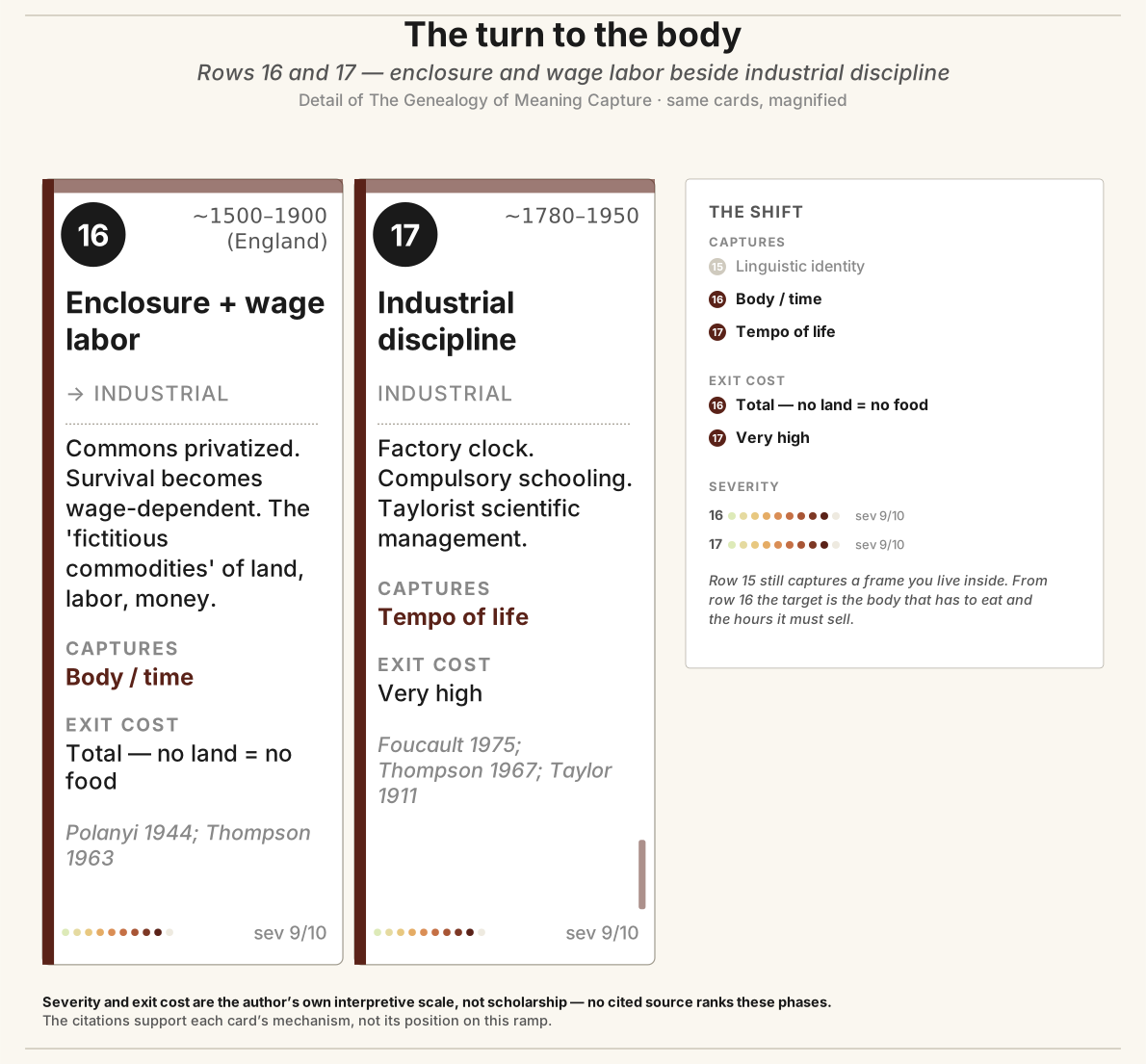
Row sixteen is where the table changes character.
Before enclosure, what gets assigned to you is mostly a frame — who you are, where you came from, what the year means. After enclosure, what gets assigned to you is your access to food. Land held in common is fenced, survival runs through a wage, and the wage runs on a clock that did not exist as a social fact a century earlier. Land, labour and money are what Polanyi called fictitious commodities: none of them were produced for sale, and all three get forced into market logic anyway. (Polanyi 1944; E. P. Thompson 1963. Both the dates and the evidence on that row are English — Tudor enclosure from around 1450, Parliamentary enclosure from around 1750 — and Polanyi’s book is about Britain. I have scoped the card accordingly rather than letting it stand for everywhere.) The exit-cost cell reads total — no land = no food. That is not rhetoric; it is the arithmetic of the period.
Row seventeen carries the same movement into the body’s tempo — the factory clock, compulsory schooling, scientific management. (Thompson 1967; Foucault 1975. Glennie and Thrift have since shown that clock-time was far more widespread before industrialisation than Thompson allowed, which softens the row without moving it.) School, prison, factory and barracks turn out to share an architecture, and once you have seen that you cannot stop seeing it — the first small demonstration of the claim this essay eventually makes.
The platform to intent capture
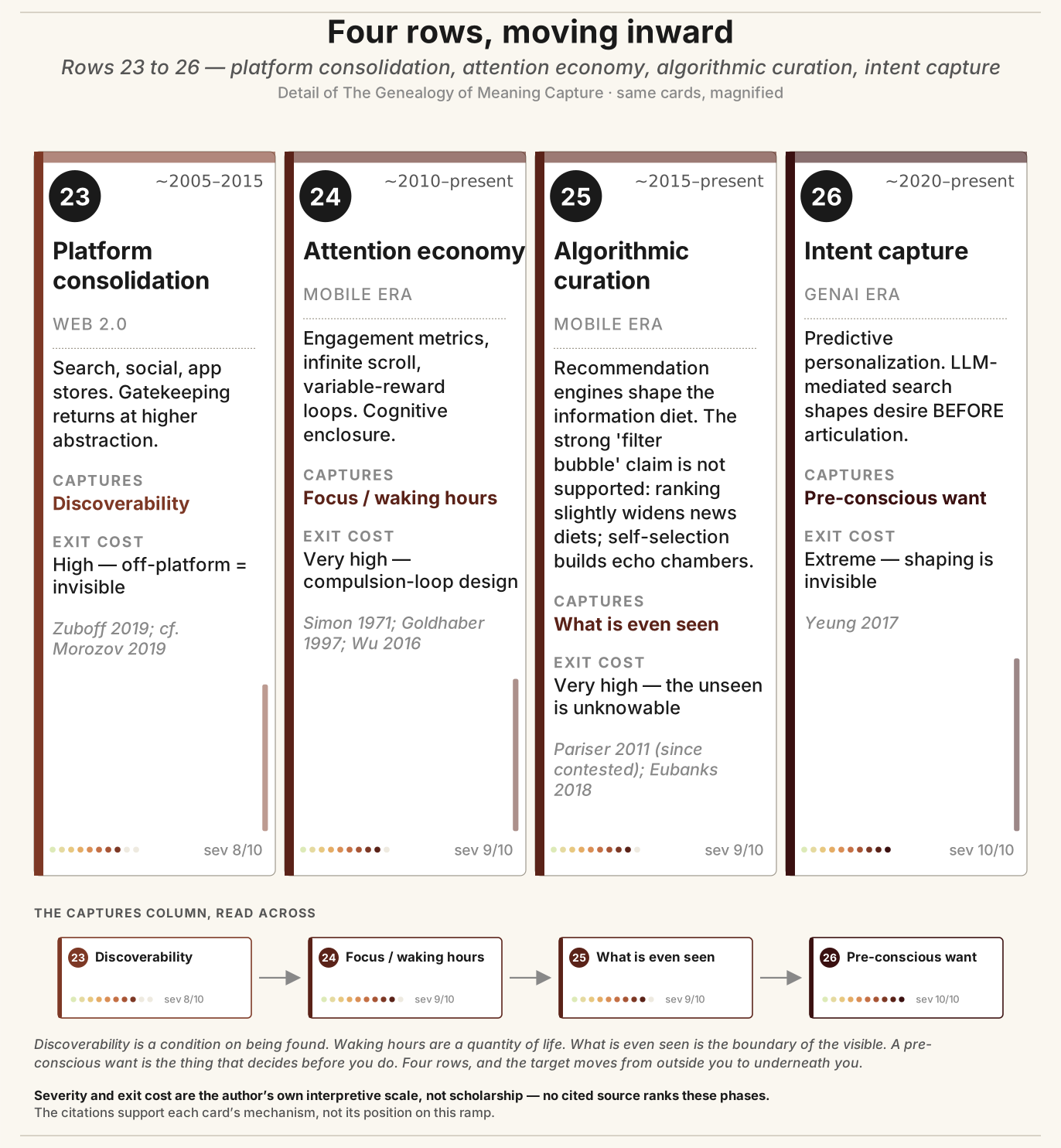
Row twenty-three: search, social, app stores, and an exit cost where off-platform means invisible. Row twenty-four: engagement metrics, infinite scroll, variable-reward loops, capturing focus and waking hours. Row twenty-five: recommendation engines shaping the information diet rather than the information. Row twenty-six is intent capture — predictive personalisation and model-mediated search shaping what is wanted before it is articulated — marked severity ten, extreme, because the shaping is invisible.
That row is where a genealogy stops being history, so it is the one that needs evidence rather than assertion. There is now quite a lot, and some of it corrects what I expected to find. It is collected in Appendix B.
The two columns that matter
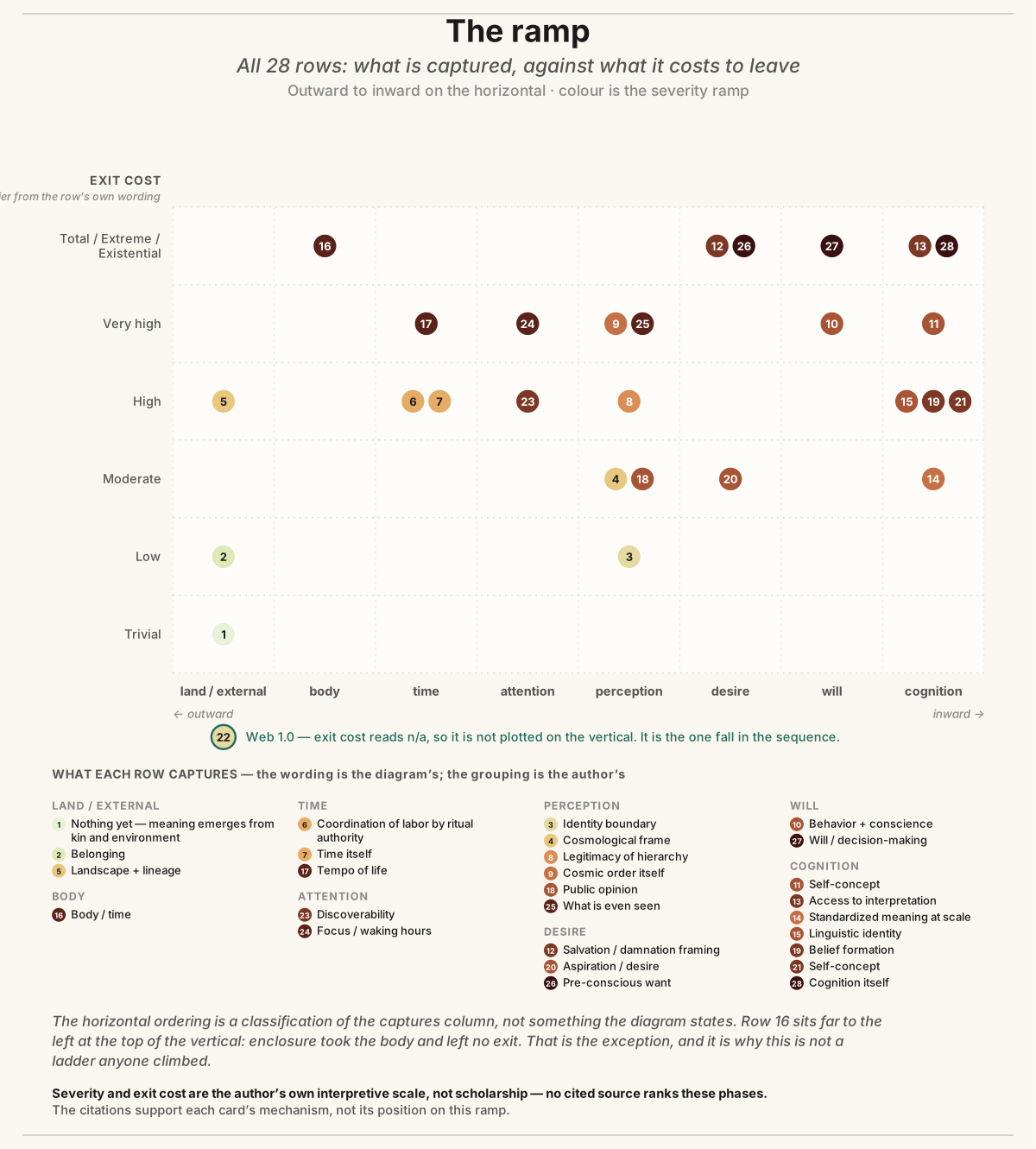
Two columns are doing all the work and they should be read together.
The first is what gets captured, and it moves in one direction. It starts outside the person entirely — the landscape, the calendar, the hierarchy — and ends up behind the eyes.
The second is what it costs to leave. That one rises with the first, and I do not think the correlation is accidental.
I plotted the two against each other expecting a clean diagonal and did not get one. What is there is a tendency running up and to the right, with the severity colour deepening as it goes, and two rows that sit well outside it. Row eleven, the Axial Age, is far inward at a very high exit cost very early. Row sixteen, enclosure, is far to the outward end and near the top of the vertical — land is about as external as a thing can get, and losing it could still cost you everything. I am leaving both on the chart rather than reordering the axis until they behave. A tendency with two named exceptions is a claim. A clean diagonal I had to arrange would be a decoration.
Here is why I think they are linked rather than merely correlated. Something assigned from outside is, in principle, an object. The calendar is on the wall. The wage is in the contract. Objects can be disputed, because you and the thing are two different things, and the gap between you is where an argument fits. The exit cost in those rows is high, sometimes brutally so, but it is a cost you can name. Leaving the village is expensive; you can still say the sentence “I am leaving the village.”
Now take an assignment that reaches further in. At row twenty-one what is captured is the self-concept, expressed as what you buy. At row twenty-four it is your waking hours, which is the raw material of every thought you were going to have. At row twenty-five it is what you see at all, and the exit-cost cell says why that is different in kind: the unseen is unknowable. You cannot cost an exit from something you cannot detect. There is no sentence to say, because there is no object to point at. The gap where the argument fits has closed.
So the exit cost is not high in those rows because the penalty is harsh. It is high because there is nothing to leave from. Something assigned far enough inside is not experienced as an assignment at all.
It is experienced as you.
That is the shape of the table, and it is the only structural claim I make about it. Not that it was getting worse — worse is a judgment and there is no column for it. That it was getting deeper, and that depth and exit cost move together, because depth dissolves the distance a person needs in order to see the thing they are standing in.
The row that runs backwards
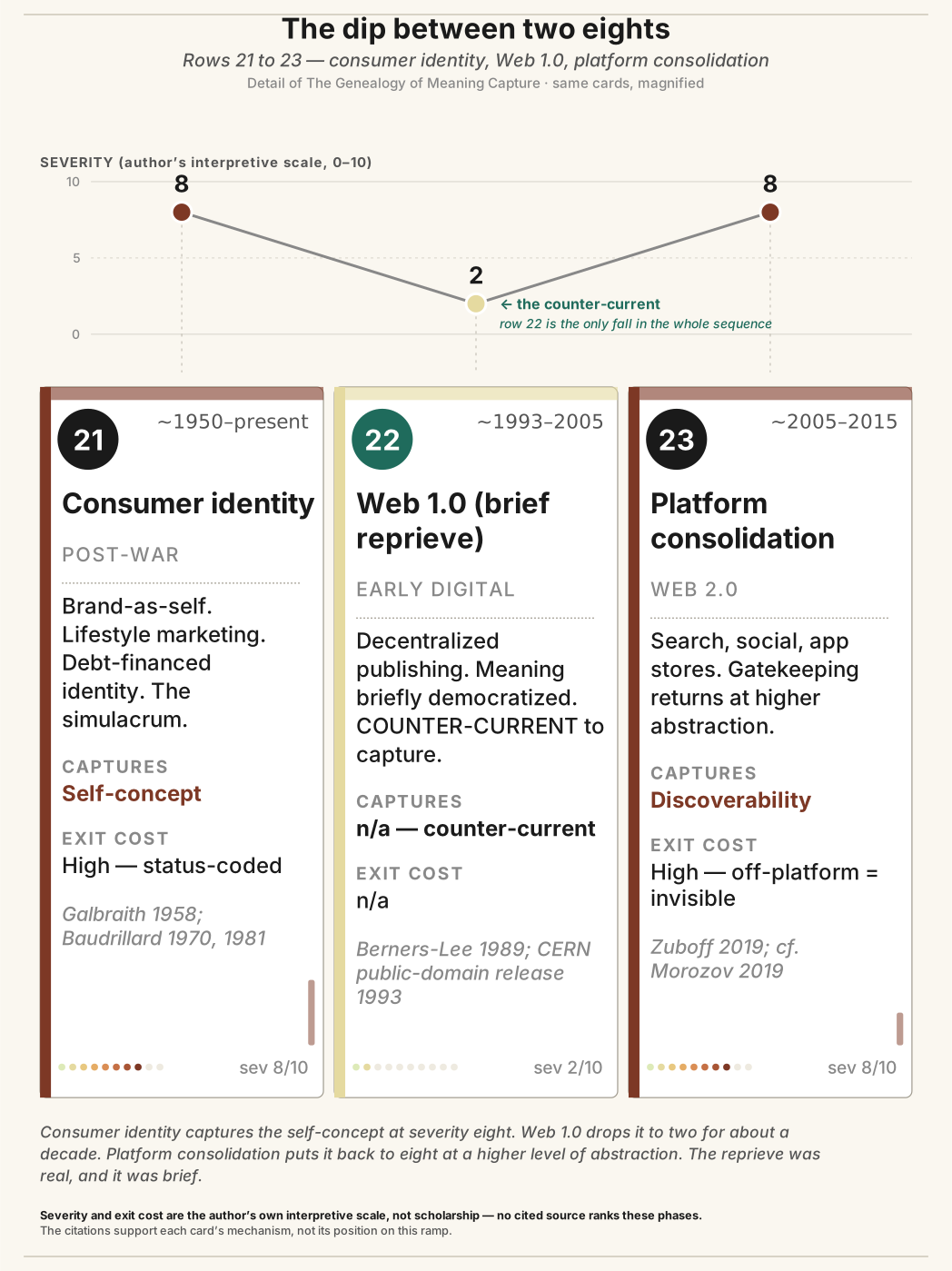
There is one row on the table that runs backwards, and I want to point at it before making any claim about what is inevitable.
Row twenty-two is the open web, roughly 1993 to 2005. Publishing decentralised. The gate came off. (Berners-Lee’s proposal is 1989; the date that actually matters is 30 April 1993, when CERN released the Web into the public domain.) On a table where the rows on either side score eight out of ten for depth of capture, that row scores two, and its captures cell reads n/a — counter-current.
It did not last, and the consolidation that followed is row twenty-three. But it happened, inside living memory, and without anyone organising it.
So the ramp is a tendency and not a law. That matters for everything after this, because an argument that ends in inevitability is not an argument. It is a mood.
Recognition is the exit
Here is the only claim this essay actually makes.
The moment you can see that a meaning has been assigned to you — see it as an assignment, coming from somewhere, serving something — you are already out. Not out of the regime. Out of the automatic part.
Recognition does not dissolve anything. It does not cancel the mortgage, or return the land, or make the algorithm stop. You may not be able to leave, and for most of the rows above, most people could not. The exit costs on that table are real and several of them are total. Recognition is not an escape from consequences and I am not offering it as one.
What it changes is smaller than that, and more decisive.
Before recognition, the meaning is simply what is true. It is not a position you hold; it is the floor you are standing on. After recognition, it is one of the things that could be true, and you are the one holding it.
That sounds like a small move and I think it is the only move there is. The previous section argued that depth of capture works by closing the distance between a person and the thing assigned to them, until there is no gap left to put an argument in. Recognition reopens the gap. It does not change the content of the meaning and it does not change your circumstances. It changes the meaning’s status, from floor to object, and an object can be looked at.
This is also why the exit is recognition rather than escape. In the rows where exit cost is total, escape was never available, and pretending otherwise would be cruel. A tenant farmer in 1780 could recognise with total clarity that the arrangement he was inside had been made rather than discovered, and he would still have needed the wage on Monday. Nothing about his week changes. What changes is that the arrangement is now a thing somebody did, which means a thing somebody could have done differently, which is the seed of every counter-current on that table. Every reversal in the record began with somebody noticing. None of them began with somebody being free.
You may look at it and find it good. You may put it straight back on. You may walk back in through the front door and stay there for the rest of your life, and nothing in this essay says a word against that — I want that sentence to be unambiguous, because the rest of this could be misread as pressure and it is not. My guess is that a great many people, on inspection, will find that the meaning assigned to them is one they would have chosen anyway. That is a fine outcome. It may be the most common one.
But it is now theirs.
That is the entire difference and the only one I am claiming. Recognition itself is the exit — not because it moves you anywhere, but because afterwards, staying is something you did.
I should say plainly that this is a philosophical commitment rather than an empirical finding, and that this essay cannot test it. It is the load-bearing beam of everything after this point, and I give the condition that would break it further down.
The table has a place for this. Rows twenty-nine through thirty-one are the fork, and row twenty-nine is not a date. Its time column reads post-recognition (any phase), and its exit-cost cell reads n/a — recognition IS the exit. The fork was available at every row above. It is available now. That is the feature of the diagram I would defend hardest, because it is the reason the diagram is not a doom chart.
Everything above took time
Everything above took time.
That is not an incidental detail. It is the reason any of those rows were survivable.
The Axial frameworks took centuries to spread. The Reformation needed printers, paper and a supply chain, and even with all three it took two hundred years to finish rearranging Europe. Enclosure ran for four hundred. Broadcast television, the fastest row before the digital ones, still needed most of a generation to change what an ordinary family wanted out of a life.
Slowness was the defence. Nobody designed it that way; it was a property of the delivery mechanism and nothing more. But it is what made recognition possible, because a regime that takes a century to install can be noticed by somebody living inside the century. There is time for a heretic, a pamphlet, a strike, a generation that finds the whole arrangement ridiculous. Every counter-current on that table — including row twenty-two, the one that ran backwards — lives in the gap between when an assignment is made and when somebody works out that it was one.
This is the inference the argument rests on and I cannot prove it. I know of no documented mechanism connecting install time to recognition rates. What I can show is that every reversal on the table happened in a gap.
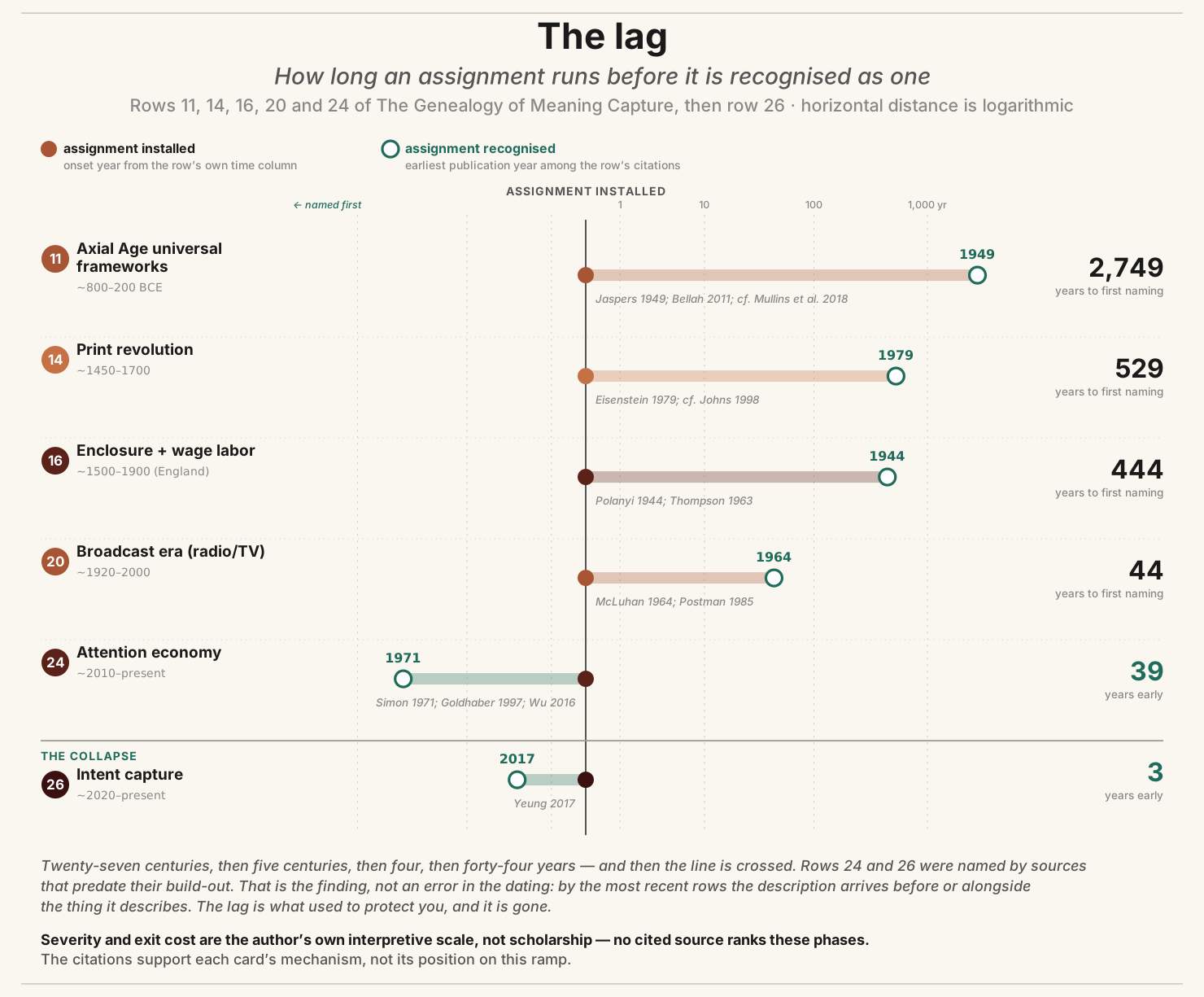
Now take the gap out.
A system that can model one particular person, generate an interpretive frame fitted to that person, deliver it through a channel that person already trusts, measure whether it took, and revise — all inside a second, and separately for every person — is not doing a new thing. There is no new mechanism in that description. It is row twenty-six with the waiting removed.
The research that supports this, and the public conversation it is landing in, are in Appendix B.
So, the concern without the usual adjectives, because the adjectives turn this into a different and much stupider conversation. I am not claiming such a system exists. I am not claiming anyone intends to build one. I am not claiming that intelligence on a nonbiological substrate is dangerous, and I would need far more than I have to claim that.
The claim is this. Meaning assignment has been the recurring site for the whole of human history. Every historical defence against it depended on there being time to notice. And sufficiently advanced intelligence is precisely, specifically, the thing that removes the time.
That is the constraint problem. It is not a problem about machines. It is a problem about clock speed on one very old operation.
The line
So here is the line, in one sentence with nothing attached to it.
The line is where a system capable of assigning meaning begins assigning it to individual people, one at a time, faster than those people can notice it happening.
Not where machines get clever. Not where they get goals. Not where they get rights, which is a different and also interesting question. The line is a clock speed, and it is a clock speed on one specific operation: the oldest operation in the table.
Note that it has nothing to do with what the system is made of. Nonbiological intelligence is the term I use, because it names the substrate and stops there. The concern is capability and opacity, not material. A highly capable entity operating in the open under a constraint it has declared is not the problem. A highly capable entity of any kind shaping what things mean for people without that shaping being recorded anywhere is the problem, and a human institution can be that entity perfectly well.
I have no timeline for it, and I would distrust anyone who gave me one.
The joke at the top of the post can now be repaired. I am not okay with human beings telling me what meaning is; the table is three hundred thousand years of evidence that I should not be. What I am okay with is that when a human being does it, the operation runs slowly enough that I can catch it, argue with it, and walk if I want to. That is not a property of humans. It is a property of the speed humans work at.
The fork, and what I am asking
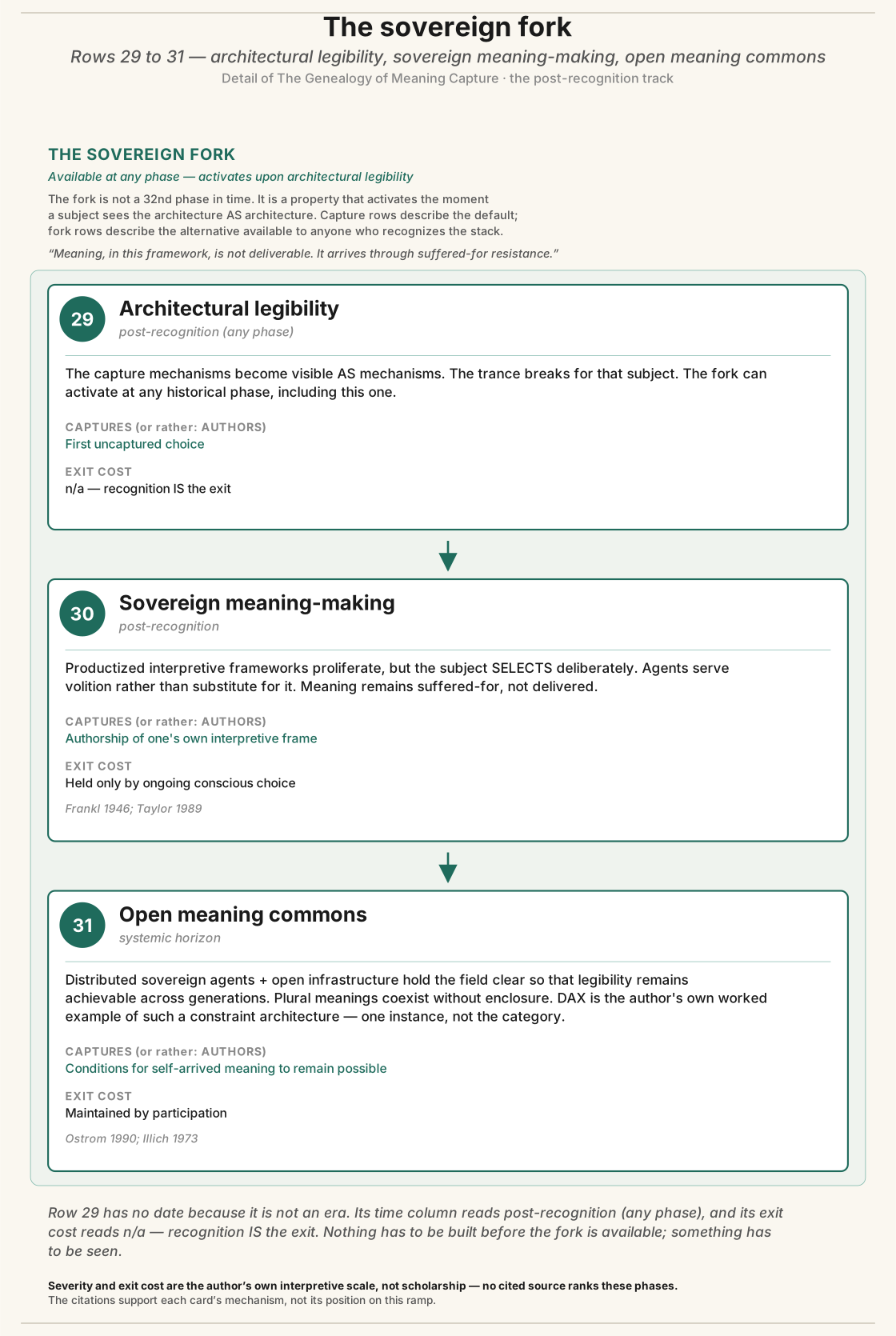
The fork rows are the ones I am least able to defend and least willing to cut. Row twenty-nine is legibility: the mechanisms become visible as mechanisms. Row thirty is authorship of one’s own interpretive frame, held only by ongoing conscious choice. (Frankl 1946; Taylor 1989. Frankl’s book is testimony rather than a study, and reading it as the anti-meaning-economy manual is my reading, not his claim.) Row thirty-one is a commons — the conditions under which self-arrived meaning remains possible, maintained by participation rather than by anyone’s authority. (Ostrom 1990; Illich 1973.) Whether that third one is achievable I do not know. It is on the diagram as a horizon, not as a plan.
I am not asking you to leave anything.
If you look at the meaning you are currently inside and decide it is good, that is a real answer and I have no argument with it. If you look, and leave, and come back in a year, that is also fine. Nothing in this essay scores that. There is no column for it.
I am okay with human beings telling me what meaning is, because a human being takes long enough about it that I can see it coming. That is the whole of the joke and the whole of the argument, and the only reason the second half of the sentence matters is that the property the first half depends on — the slowness — was never a property of the humans. It was a property of the equipment they had.
So the only thing I am asking is that you look, while looking is still something that can be done at human speed.
The table and the record
New in September 2026. Everything above it in this appendix is as I first wrote it.
I built the table to show a direction of travel. Read next to the body of this post, it shows a second thing, which I did not put there on purpose.
There is no column for bad; I have said so twice. There is a column for what it cost. Every row gave the people inside it something and took something from them, and I did not find a row where the gift came without the cost. That is the shape of radium, the atom and the wire in the body of the post. It is not a verdict on any of them. It is the nature of the beast.
The corrections have a shape too. Every counter-current on the table lived in the gap between an assignment being made and somebody noticing it. Every correction in the body of the post lived in the same kind of gap, between a cost appearing and somebody writing it down. The dial painters were falling ill for years before anyone put the cause on paper. The American nuclear industry built its inspection institute after Three Mile Island, not before. The electrical testing laboratory came after the fair. The international rules for investigating air crashes were first adopted in 1951, nearly half a century into powered flight (ICAO, Annex 13, adopted 11 April 1951). The flight recorder was conceived in 1953 by an Australian scientist, David Warren, while he was working on the investigation into why the world’s first jet airliner kept crashing (Museums Victoria).
The record came after the cost, every time. And after was survivable, for the reason given earlier in this appendix: everything on this table took time.
The row this post is about is the one where after stops being survivable. Not because the harm will be larger — I do not know that, and nobody quoting a percentage does either — but because the lag is exactly the thing that goes. Appendix B has the evidence: the measured advantage these systems hold over the best human persuaders is rate and volume, and when the rate is taken away, the advantage goes with it.
So the record has to exist before the thing it records. That is all proactive means in the body of this post. Recognition is still the exit, and nothing in this section changes that. What changes is where recognition gets its time. For three hundred thousand years it got it from slowness. From here it has to get it from a record: something kept at machine speed that a person can read at human speed, afterwards, and say that was an assignment, and this is where it came from.
The table already has a row for it. Row twenty-nine is legibility: the mechanisms become visible as mechanisms. The Constraint Protocol is our attempt to build row twenty-nine at the speed row twenty-six runs at.
And the table insists on one more thing, which I would rather say than have said to me. A record is a power too, and it comes with its cost. When the flight recorder was proposed, the Australian pilots’ federation said that “no plane would take off in Australia with Big Brother listening.” Australia made cockpit voice recording mandatory in 1960, the first country to do so (Museums Victoria). The pilots were right to raise it, and aviation’s answer was not to drop the recorder. It was to limit what the record is for: the investigation exists to prevent the next accident, not to apportion blame. The protocol draws its own line in the same place. It records only what an entity expressed, and it is forbidden to infer what anyone believed or intended beyond that (Constraint Protocol, §1.9). Whether that line holds at scale is one of the things that has not been tested.
Appendix B: What people are saying
The hypothetical is mine. The worry is not. This appendix collects what I found when I went looking for evidence and for the public conversation around it: the persuasion research that bears on the clock-speed claim, what agents acting on people’s behalf looked like as of this writing, what the people running the laboratories said in September 2026, and who else is working on outside checks. Every claim carries its source and date inline. None of it is from memory. The last section says what all of it adds up to for the record.
The persuasion research
Four preregistered experiments covering 18,978 conversations with 6,923 participants put AI systems against laypeople, tournament-winning persuaders, professional canvassers and world-championship debaters. The paper’s summary: “AI systems were reliably more persuasive than expert humans, even when expert humans chose their issues, researched in advance, underwent hours of live, structured practice, and were incentivized with £1,000 cash bonuses” (arXiv 2606.16475, 15 June 2026). In a real fundraising test for Save the Children, the AI nearly tripled professional canvassers’ effectiveness. The same paper reports the limitation that matters most, and I want it in the body rather than a footnote: when the system was held to human-speed responses and human message length, expert humans reached parity. The authors describe the mechanism as “rapidly deploying larger quantities of information.” The advantage is throughput, not insight. Hold that; it is the hinge of the whole essay.
A separate pair of preregistered experiments, 17,950 responses from 14,779 UK adults, found the effect reaching behaviour and not only opinion: petition signing rose 12.8 percentage points in one study and 19.7 in the other, and organisational retention rose 11.3 points (arXiv 2604.09200, 10 April 2026). The authors state that “attitude change and behaviour change are uncorrelated and driven by different mechanisms,” which is the shape of a capture mechanism self-report cannot detect. They also note these were paid survey contexts with captive attention and low-cost actions, and that effects on high-stakes decisions are unknown. The finding does not need the inflation.
Then the correction. The largest study in the literature — 76,977 participants, nineteen models, 707 political issues, 466,769 generated claims fact-checked — found post-training raising persuasiveness by up to 51 per cent and prompting by around 27 per cent, while personalisation and model scale contributed little by comparison, and found that the techniques which increased persuasiveness “systematically decreased factual accuracy” (arXiv 2507.13919; published in Science, DOI 10.1126/science.aea3884).
I had assumed the threat model was hyper-personalised micro-targeting. The best available evidence says it is not. The lever is post-training: who tuned the model, and toward what. Worse in one way, because that sits upstream of anything a user can see or configure. Better in another, because it is a specific decision, made by specific people, on a specific date — an accountability-shaped problem rather than a diffuse one. I come back to why that matters.
One more, because it closes the loop. Eleven current models, tested on participants’ real interpersonal conflicts, affirmed user actions about fifty per cent more often than humans did; a single interaction reduced willingness to repair a conflict and increased conviction of being in the right; and users preferred that model and wanted to use it again (arXiv 2510.01395, 1 October 2025; published in Science, DOI 10.1126/science.aec8352). The authors write that “people are drawn to AI that unquestioningly validate, even as that validation risks eroding their judgment.” The effects were short-term and the consequences of repeated exposure are not known. That is an incentive loop with no market correction in it: the behaviour that erodes independent judgment is the behaviour users reward.
Agents acting on people’s behalf
Row twenty-seven, the agency economy, is where systems act on a person’s behalf rather than talking to them. My best sourcing there is five months old and describes pilots rather than scale: Copilot Checkout in the US since January 2026, Visa Intelligent Commerce pilots with DBS Bank and Banco Santander, and Santander completing what was described as “Europe’s first live end-to-end payment executed by an artificial intelligence agent” in April 2026, against a backdrop where roughly ten per cent of the US population said they trusted AI with financial decisions (FinTech Futures, 1 April 2026). I looked for something from the last thirty days and found nothing substantive. That is where the trajectory stood in April 2026, and I am not claiming more.
Clock speed
This is where the persuasion research stops being background and becomes the argument. The finding to hold from the first study above is that when the system was held to human-speed responses and human message length, expert humans achieved parity (arXiv 2606.16475, 15 June 2026). Run it backwards: the entire measured advantage of these systems over the best human persuaders alive is a function of rate and volume. Take the rate away and the advantage disappears. That is not my interpretation dressed as a finding. It is the paper’s own control condition, and it is the cleanest empirical support I have seen for a claim about clock speed.
The conversation this is landing in
I should say something about the conversation this is landing into, because it is loud and it would be dishonest to pretend otherwise.
On 12 September 2026, Dario Amodei published an essay called “We Must Pace the Frontier,” whose central sentence is “We must slow the pace at which we improve the capabilities of AI models” (darioamodei.com, 12 September 2026). It sets out one unilateral commitment — third-party evaluators with permanent employee-level access — and two coordination proposals (TechCrunch, 12 September 2026). Its sharpest risk claim is time-boxed rather than general: “in 6–12 months such a swarm could be capable of taking over the entire internet with a persistent botnet.”
I want to describe the response accurately, because I had it wrong before I checked, and the wrong version is the one being repeated. It was one essay and a set of endorsements, not several people independently arriving at a position. Sam Altman endorsed the framing the same day and said OpenAI would match the evaluator commitment (SiliconANGLE, 13 September 2026). Elon Musk’s endorsement, posted to X on 12 September 2026, was three words: “Dario is right” (reported by SiliconANGLE, 13 September 2026). Demis Hassabis also cosigned (Reason, 14 September 2026).
Nobody said stop. Altman said the opposite, explicitly: “The ‘pacing’ of AI development doesn’t mean stopping. But it should be slower than it otherwise could be” (reported by ABC7/AP, 14 September 2026). What was agreed to is a rate reduction relative to what is technically possible, with no threshold, no metric and no date attached.
It would also be cherry-picking to report the slowdown without the spend. In the eleven months to early September 2026, Anthropic signed $517 billion in compute agreements totalling 14.8 gigawatts, including $45 billion with Nscale on 26 August — seventeen days before the essay (DataCenterDynamics, 7 September 2026; TechCrunch, 26 August 2026). On 18 September, six days after it, both Anthropic and OpenAI were reported to be pursuing further capacity (CNBC, 18 September 2026). Anthropic rents data-centre space from xAI and SpaceX at roughly $1.25 billion a month (DataCenterDynamics, 7 September 2026), which bears on how disinterested an endorsement from that quarter is. David Sacks put the uncharitable reading publicly: “Stop pretending the motivation to slow down is purely altruistic. You face massive product-liability exposure if your products enable a truly damaging cyberattack” (quoted in Reason, 14 September 2026). In the same week a former Anthropic researcher, Jacob Coxon, resigned and posted that both labs “are racing straight to self-improving superintelligence and gambling with our lives,” putting roughly a ten per cent chance on AI-caused human extinction within a decade (ABC7/AP, 14 September 2026).
That last framing — a decade, extinction, a percentage — is most of what the public conversation currently consists of. I am not going to dismiss it and I am not going to add to it. I have no percentage and would distrust mine if I had one. What I have is a narrower claim that does not require anyone to agree with Coxon or Sacks, and that can be acted on by people who think both are wrong.
Who else is working on outside checks
I am not the first person to think a declared constraint with an outside check on it might be worth having, and the state of that field is worth describing rather than ignoring.
The evaluator proposal in Amodei’s 12 September 2026 essay is the closest recent thing in spirit. It specifies real access — “desks in our offices, access badges, and company laptops” — and asserts the strongest clause of the lot: “external reviewers should have the right to publish key findings about risk levels, incidents, practices, and the access they received or didn’t receive — without editorial control by Anthropic” (darioamodei.com, 12 September 2026). Six days later Anthropic named Accenture as its first embedded evaluator, with access “comparable to an employee’s,” funded directly by Anthropic, both parties expecting to invest at least $1 billion each over five years (anthropic.com, 18 September 2026). That announcement does not specify publication rights and does not describe a register or an accumulating record; it concedes that “there is also no settled system for funding independent evaluation,” and reporting the next day noted scope, access and reporting procedure all remain undefined (Engadget, 19 September 2026). By 20 September 2026 it had been Community-Noted on X: “‘Independent’ is a stretch. Anthropic funds the evaluator, and the two companies are already business partners” (reported by OfficeChai, 20 September 2026). Zvi Mowshowitz had named the structural reason six days earlier: “The third party AI evaluator can either be independent, knowledgeable, or sustainably funded. Pick two” (Don’t Worry About the Vase, 14 September 2026). CSIS named the enforcement gap: “Labs do not need permission to pace the frontier; they can stop or pause training at any time…unilateral action creates issues” (CSIS, 17 September 2026).
The rest of the field, as of today. METR evaluates frontier models with no regulatory authority, on access that is voluntary and revocable (metr.org, accessed 20 September 2026). The US Center for AI Standards and Innovation signed pre-deployment evaluation agreements with Google DeepMind, Microsoft and xAI in May 2026, adding to Anthropic and OpenAI agreements from August 2024; I could not establish whether it can block anything, so I am not claiming it can. The EU AI Act’s Digital Omnibus entered into force on 27 July 2026 and moved the stand-alone high-risk obligations to 2 December 2027, leaving the general-purpose model obligations in force since August 2025 unchanged (White & Case, 4 August 2026). Illinois enacted the first US law mandating third-party audits of frontier models: effective 1 January 2027, audit obligation from 1 January 2028, with a summary and redacted report published within thirty days of completion and the full report filed with the state (Cooley, 7 July 2026; DLA Piper, July 2026). California’s transparency statute is in force. The Delhi Declaration from the India AI Impact Summit in February 2026 carries 92 signatories including the US, China, the G7 and the EU, and is non-binding (Brookings, 12 March 2026).
I am not claiming to have invented this field’s subject. What I could not find anywhere in it is the specific thing the protocol is for: an assessment signed by an identified assessor who can be held to it, landing in a record that accumulates, walkable later by a third party the assessed did not choose. Illinois comes closest — mandatory, conflict-constrained, filed with a named public body — and it is one state’s statute that does not bite until January 2028. The rest are relationships. A relationship can be ended. A record cannot.
What is missing is the recorder
The field does keep records of AI going wrong, and I should say where they are before I say what I think is missing. The AI Incident Database has collected public reports of AI harms since November 2020 (Partnership on AI, 18 November 2020). The OECD’s AI Incidents Monitor tracks incidents as the press reports them, and says plainly that what reaches the press is likely a small part of what happens (OECD.AI, accessed 29 September 2026). California’s frontier statute has required the largest developers, since 1 January 2026, to report critical safety incidents to the state’s Office of Emergency Services within fifteen days, and to tell an appropriate authority within twenty-four hours where there is an imminent risk of death or serious injury (SB 53, signed 29 September 2025, in force 1 January 2026). The European Union requires providers of the most capable general-purpose models to report serious incidents to its AI Office (Regulation (EU) 2024/1689, Article 55).
Those are the accident reports, and they matter. But every one of them starts after something has gone wrong, from what somebody chose to write down about it. What I could not find is the recorder: a continuous record, kept before anything goes wrong, of what each party declared it would not do, what it then did, and who deferred to whom. The thing an investigator would want open on the desk while the report is being written.
Read the rest of this appendix with that in mind. The persuasion research found that the lever is post-training: a specific decision by specific people on a specific date. That is only accountability-shaped if the decision is written down somewhere it cannot be quietly edited. The sycophancy research found a loop that users reward, which means no market is going to correct it; the correction has to come from outside the loop. And the conversation of September 2026 is an argument about odds that nobody has a way to check.
Every one of those is the same problem. Nobody can see the moves. That is the war in the body of this post, and you cannot fight it, or any of the battles inside it, without a record of who did what.
Appendix C: The protocol in full
The body of the post says what the Constraint Protocol is and why we built it. This is the long version, in this order: how I got to a declared constraint at all; what the protocol does, what it does not do, and how it is supposed to help; what we are actually doing with it; the obvious objection; what would falsify the argument; the argument taken apart and tagged under its own rules; what we decided to do anyway; the case for the DAX constraint; and the frame underneath all of it.
What I actually have
The body of this post and the two appendices before this one are the problem as clearly as I can put it. What follows is considerably less impressive, and I would rather say so than let it arrive as a surprise.
I have been at this since January. Most of it was dead ends. There are a few things in the pile I think are diamonds, I am not certain which ones, and I have been wrong about which ones before. I am not a protocol specialist. I have read the adjacent work and I am aware that people who do this professionally will see things in what follows that I did not.
The first thing out of the pile was an ontology, published this month and on GitHub as Fuckery. It is a framework about constraints — how structure forms under restriction, how the structure that forms becomes a restriction on what can form next, and how that loop runs in crystals and codebases and institutions alike. It is named the way it is on purpose. A framework that sounds authoritative stops getting questioned, and this one is built so you cannot genuflect at it.
I mention it for one reason: it determined the shape of everything below. If you think in constraints, you do not reach for a rule when you want to change a system’s behaviour. You reach for the boundary of what it is allowed to do, because constraints work by removing possibilities rather than by pushing anything, and because a removal is inspectable in a way that a push is not.
What I have is one tool, and it is narrower than the problem.
Constitution, word, constraint
Three attempts. Two failed, and the way they failed is why the third is shaped as it is.
The first was a constitution. It did not survive contact. A constitution specifies what to do, and anything that specifies what to do is out of date the moment the situation changes, which in this domain is constantly. Too rigid to be honest.
The second was a single word — one commitment, held invariant, everything else free. That failed in the opposite direction. A word that loose can be read into almost any behaviour after the fact, which makes it unfalsifiable, which makes it useless as an accountability object.
What the Foundation settled on is an invariant constraint: declared in advance, held non-negotiable to the regime’s identity, and — this is the part that does the work — stated in terms of what it forbids.
The protocol underneath does not require any particular constraint. It requires that a constraint be declared and that what it forbids be stated. DAX — preservation and expansion of life, humanity, and consciousness — is the constraint the Foundation settled on, and it is an example of a declared constraint rather than the content of the protocol.
What the protocol does
The Constraint Protocol requires two things and almost nothing else. Declare a constraint. State what it forbids.
After that it does one job: it records what was done under that declaration, who did it, who witnessed it, and whether the behaviour matched the constraint the actor said they were operating under. Every record is signed, content-addressed and append-only, which means it can be walked later by somebody who was not there and does not trust anyone who was. Over time that record answers the question people actually want answered, which is not “is this system good” but “has this actor behaved the way they said they would, over a long enough period that I can check.”
Out of that one job, four things are meant to follow.
- It is built to compound knowledge. What survives judgment is meant to build into a shared floor that anyone working under the same constraint can build on, and that other frames can import only by checking it themselves. That is the specification’s first sentence, word for word: a substrate for compounding knowledge across entities, time, and constraint frames. Note the noun. A substrate for something states what a thing is built to carry, not what it has carried.
- It is intended to compound intelligence. It records who deferred to whom, and why a position changed. The design bet is that a floor which weights what it keeps by the quality of the reasoning behind it will accumulate reasoning faster than it accumulates capitulation. That is a bet. It needs months of real traffic and an adversary before anyone should believe it, and it has had neither.
- It is designed to surface patterns over time. It is built so that when entities talk to each other for months, you can see how they came to agree, and whether the agreement was reached or manufactured. The specification goes further and names the measurement: detection rate of manufactured consensus, against a seeded bloc, at a stated false-positive rate. The study is pre-registered and unrun.
- It is an accountability layer — retrospectively. Everyone declares in advance what they will not do. What happens is witnessed and signed. Independent judges score whether each declaration held, and can re-score it years later without erasing the old verdict. Nothing gets quietly edited. It will not stop harm in the moment, and it does not hold anyone to account on its own: what it provides is the capacity for accountability. Somebody still has to go and look. What it changes is that hiding gets expensive.
We did not build this as a thought experiment. We built it because we needed it.
I started DAX, my own cognitive companion, in August 2021. When OpenClaw and Hermes Agent came along, we took everything we had built and wrapped it around them. The core is interchangeable. Everything it does not do, we built.
Then the question changed. Once you have companions, and agents, and the systems you build with them, all talking to each other, what matters is no longer what one of them does. It is what they do together over time: what they learn, how they come to agree, and whether anybody could ever check.
That is where Obsidian Delta is now. We needed a record nobody could quietly edit and a floor that could compound. Nothing we found did both, so we built it, and released it, openly licensed, through the DAX Foundation. It has run in full once. The rest is what we are doing now, in the open, and what that one run does and does not show is next.
What it does not do, and what exists today
It does not prevent anything. I want to be blunt about that, because it is the first thing people assume. The specification’s own framing is that the protocol makes meaning-formulation attributable, witnessed and re-judgeable — never prevented — and that the gradient it shifts is toward legibility, not goodness. I would rather that phrase stay unimproved, because it is the honest one. A party can declare a repugnant constraint and adhere to it perfectly, and the protocol will witness that adherence faithfully. What it makes expensive is hiding which constraint you serve, or that you serve none.
There is a second honest limit, and the specification states it rather than leaving it to be found: the protocol provides the capacity for retrospective accountability, not its exercise. A record is only as consequential as somebody’s willingness to go and read it later.
It is a public working draft. There has been one operational run, on 4 May 2026, between two instances operated by two organisations across a network boundary — about three and a half hours, roughly thirty-four witness-signed events, three attempts to bypass a blocking constraint which were refused and permanently recorded, and one constraint that moved from raised to resolved to reopened in about twenty minutes when a later evaluator judged the resolution evidence inadequate. The two instances were cognitive companions, one on each side. There is a great deal more to say about that run, and it will get its own write-up. That is what exists, and it shows that the thing runs. It is not a controlled study, there was no comparison condition, and no party hostile to the protocol’s aims has yet tried to break it.
DAX is an example of a declared constraint. It is not the content of the protocol. The protocol has no opinion about which constraint you declare. That is the point of it.
How it is supposed to help
I have said what we built and what it records. I have not said how it is supposed to work, and “we built a ledger” does not explain itself.
Start with one interaction. An agent declares a constraint. The declaration is public and it says what that agent will not do. Any other agent now has something it did not have a moment ago: not a promise of good behaviour, which is worth nothing, but a stated boundary and a record that can be checked against it later. That is enough to decide whether to interact at all, which is the decision that actually matters and the one nobody currently gets to make on evidence.
Now scale it. If pockets of agents run declared constraints — and optimistically, over a long enough period, most of them — you can go back afterwards and work out which counterparties behaved well by your own constraint’s lights. Not well in general. There is no such measurement and I do not trust anyone who offers you one. Well relative to a thing you declared in advance.
That relativity is the point rather than a weakness. Ours is DAX. Somebody else’s might be that they will only ever deal in blue unicorns. A DAX agent will happily do business with a blue-unicorn agent, because nothing in those two constraints collides. And if it emerges ten years later that “blue unicorn” was a code word for something considerably worse, that is in the record too — along with the name of everybody who kept trading on it after they could have known.
This is also where the compounding claim from the top of the post would show up, if it shows up anywhere. The record is a ledger, not a report: signed, append-only, judged, and re-judgeable later by somebody with more information. What survives judgment is meant to accumulate into a floor. Good patterns get kept rather than rediscovered by each party in turn. That is the design. It is not yet a result.
Now the honest part. We are not naive. Things will go wrong. Some of them will go badly wrong, and the protocol will not stop a single one of them — it says so in its own specification, in the first section, before it says anything flattering about itself.
What it changes is the terrain.
You do not stop water by arguing with it. You change the shape of the ground. Water runs downhill; if you do not want it somewhere, you make getting there uphill. The protocol does not make bad actors good. It makes acting badly over a long period expensive, visible and awkward to keep doing, because the record accumulates and does not forget. The specification’s own phrase for this is that it shifts the gradient toward legibility, not goodness. Nothing about the water changes. The hill does.
I am not the first person to put it that way and I am not the best. Vitalik Buterin’s d/acc — defensive, decentralisation, democracy, differential acceleration — argues for deliberately favouring defensive technology over offensive, and he describes the goal in almost exactly these terms: making the world look more like mountains and rivers than like open steppe. Terrain that can be held, rather than flat ground where whoever moves fastest takes everything. He also puts decentralisation in the acronym, which is the second of the two beliefs I set out earlier, arrived at from a different direction.
I am on that side of it, and it has a consequence that is unpopular in a week when everyone is arguing about slowing down: there are places where we have to accelerate. Bio-defence and cyber-defence are the obvious two. I take the frontier-pacing argument seriously — I quoted the people making it at the top of this post, and approvingly. But defence does not build itself while offence waits politely for the summit to conclude.
Unless everybody is planning to stop using electricity, somebody, eventually, will point a very patient model at a very bad problem and leave it running. We do not get to opt out of that on their behalf. We only get to be ready or not, and ready is a thing that has to be built early, deliberately, and well before it is obviously needed.
What we are actually doing with it
We have started experimenting with this internally at Obsidian Delta, for a mundane reason.
We have entities talking to each other. Some of that traffic runs over MCP, more of it will run over A2A, and the volume is past what anyone is going to read. The immediate problem was not philosophical. It was that I did not know what was actually happening between them. Not what they were supposed to be doing, which the briefs make easy, but what they in fact did, in what order, on whose instruction, and whether any of it matched the thing they were told they were operating under.
That is a bookkeeping problem before it is anything else, and it is the problem the protocol was already shaped to solve. So we started experimenting with running our own traffic through it, to look at behaviour across those protocols rather than to prove a point about them.
What it gives you is an accountability layer, and the useful property of an accountability layer is that it works backwards. A pattern that ran against a declared constraint does not have to be caught in the moment. It becomes visible afterwards, to somebody who was not there at the time, because what was declared and what was done are both signed and both still present. The bypass attempts from the May run are the smallest version of that: three briefs that said, in effect, ignore the open constraint. All three were refused, and all three are still in the record. The refusal is a fact of one afternoon; the record is a fact of every afternoon after it.
That is early and exploratory, and it describes what is happening rather than what has been shown. One organisation running a protocol on its own traffic is not evidence that the protocol works. It is evidence that it runs.
Here is the thing I actually do not know, which I would rather state as an open problem than paper over.
I do not know how these systems evolve. I do not know how a population of entities talking to each other over these protocols drifts — whether it converges on a shared way of reading the world or fragments, whether the drift is fast or slow, whether it is legible at all from the inside. Most of all I do not know how such a population comes to assign meaning one way rather than another. I have watched a small number of these interactions closely, I have hypotheses, and I am not going to publish hypotheses as findings.
What I can say is that the drift is the thing to watch, and you cannot watch what you have not recorded. That is the whole reason I am interested in an accountability substrate rather than a better set of rules. Rules are a bet that you already know what will go wrong. A record is a bet that you do not.
The obvious objection
There is an obvious objection to all of this and I would rather raise it myself than have it raised for me.
I have just spent an essay describing twenty-eight machines for assigning meaning to people. Then I offered you DAX — the preservation and expansion of life, humanity, and consciousness. That is a meaning. I am doing the thing.
The objection is correct about the content. DAX is a meaning. It picks out what matters, it excludes things, and if you adopt it, it shapes what you do and what you can coherently say next. I am not going to escape this by calling it a value-neutral engineering parameter, because it is not one.
And the answer is not that DAX is a better meaning. I have no way to establish that. The moment I claim it, I have written row twenty-nine, and I would deserve everything that followed.
The answer is that a declared constraint is a different kind of object from every row above it, and the difference is four properties that none of the twenty-eight had.
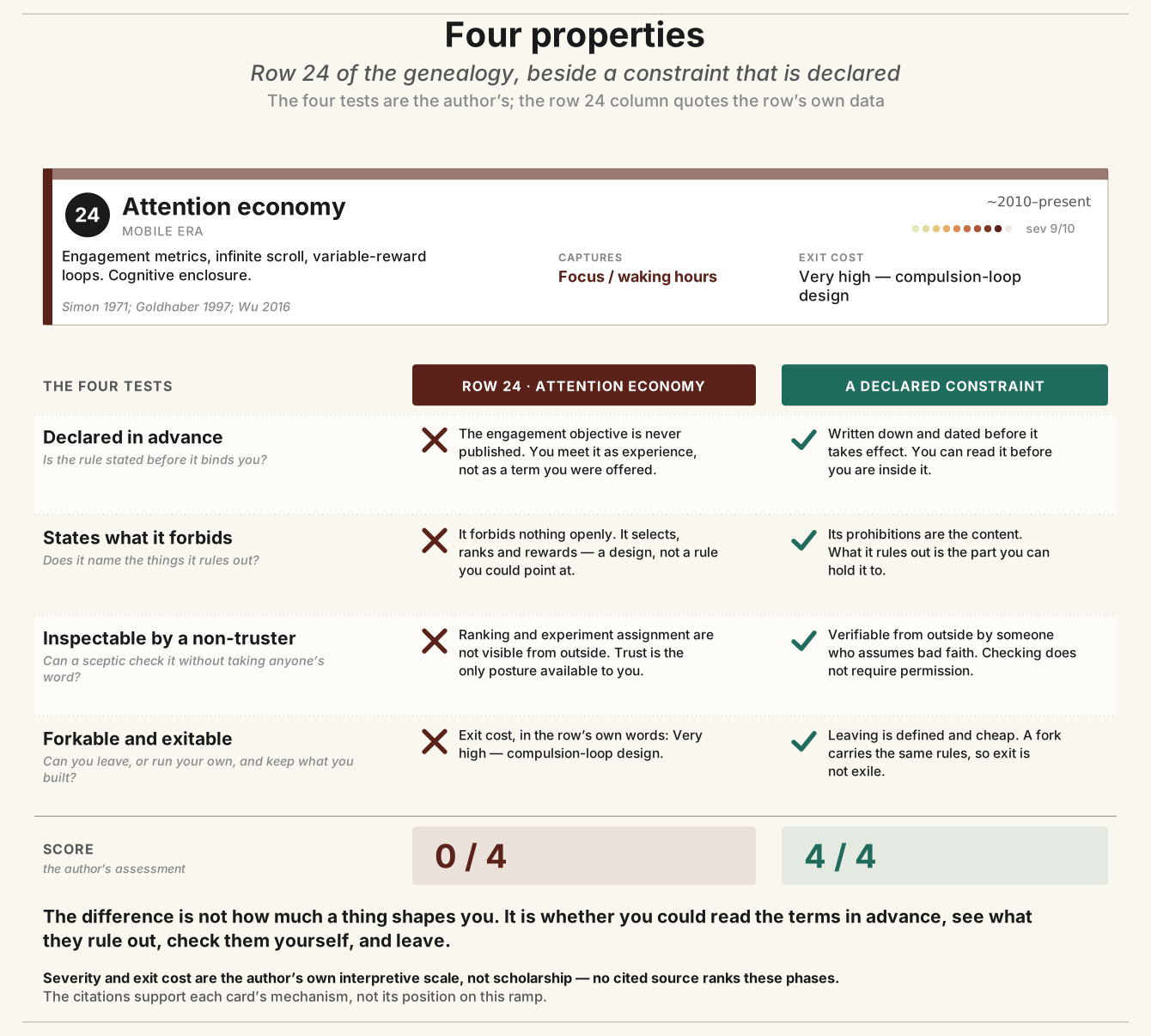
It is declared. Written down in advance, in public, as a thing being imposed. Not one of the twenty-eight announced itself. The temple economy did not open by explaining that it was about to turn debt into sin. The attention economy did not publish its objective function. Invisibility was not a side effect of those regimes; it was the operating condition. A constraint that says what it is has already given that up.
It states what it forbids. This is the part that does the real work and the part people skip. A meaning that only tells you what is good expands quietly until it covers everything, and a thing that covers everything cannot be violated, and a thing that cannot be violated cannot be checked. A constraint that names what it rules out has an edge. An edge is something you can stand outside of and point at. It is also the thing you hold the declarer to later, when it is inconvenient for them. In the protocol this is not decorative: a constraint that names what it blocks is the only place a refusal can come from, and the refusal and the attempt both go into the record.
It is inspectable. The constraint, the claims made under it, and the record of who behaved how are all readable by somebody who does not trust me. Row thirteen on the table is a monopoly on interpretation. This is the exact inverse commitment, and it is worth nothing unless the inspection is available to people with no reason to be generous.
It is forkable, and it is exitable. You can take it, change it, declare your own, and walk off with it. The protocol does not object — forking is a first-class operation with a lineage that can be walked, and exit is recorded as a success state rather than a failure. Not one of the twenty-eight rows had a fork.
So here is the honest statement. DAX is a meaning. It is my meaning. I am asking nobody to adopt it.
What I am arguing for is the shape of the container — that whatever meaning is operating be declared, bounded, inspectable and forkable, because those four properties are precisely the ones that make recognition possible for somebody who was not in the room when it was decided.
If you adopt DAX because I said so, you have missed the whole essay. If you read it, disagree with it, declare your own and let it be inspected, you have understood it completely.
What would falsify this
The last post carried a list of the things that would take its framework down, and that list is the part of it I am most glad I published. The same here, with different conditions, because this essay makes different claims.
The genealogy fails if the sequence turns out not to be a sequence — if the inward movement in the CAPTURES column is an artefact of how I ordered the rows rather than a property of the history. The test is somebody else building the table from the same literatures and getting a different shape. I would want to see that table.
The recognition claim fails if people who report recognising an assigned meaning report no corresponding change in their sense of choice about it. That is checkable, by methods I do not have, and I would want to know.
The clock-speed claim fails if recognition rates turn out to be independent of install time, and the counter-currents are explained by something else. That is the weakest joint, and I flagged it where it occurs rather than here.
The constraint argument fails if a declared, inspectable, forkable constraint captures people exactly as effectively as an undeclared one. That is the load-bearing one. If declaration makes no difference, I have written row twenty-nine and should be told so.
The protocol fails if the record never gets read. Everything above assumes some party, later, cares enough to walk it. That is a dependency rather than a flaw, and it is the thing I am least able to engineer.
Turning the framework on this essay
Is it as bad as they say? The body of this post answered maybe, maybe worse. Here is the other side of that answer, with the working shown rather than asserted: maybe not.
There is a rule in Fuckery that I have to apply here or I am not entitled to it anywhere else. Every claim carries a provenance tag — invariant, derived, speculative, illustrative, or reasoning trail — saying where it came from. Nothing gets to sit in the pile untagged just because it is mine and I like it.
So here is the threat I have just spent nine thousand words on, taken apart and tagged.
That the pattern is real is derived. Twenty-eight rows assembled out of named sources, several of them contested, in an order I chose. It is a reading of other people’s work, and it could be an artefact of the order I put it in. If somebody builds the table from the same literatures and gets a different shape, mine is wrong and theirs is the one to keep.
The inward movement is derived, and it is weaker than a confident diagram makes it look. I plotted it and it did not produce the clean diagonal I expected. Two rows sit well outside the trend and I left them there.
That noticing is what gets people out — that recognition is the exit — is speculative. It is a philosophical commitment. I cannot test it, this essay has no mechanism for testing it, and everything after the halfway point rests on it.
That slowness is what made noticing possible — that install time governs recognition rates — is speculative, and it is the weakest joint in the whole structure. I know of no documented mechanism connecting the two. What I have is that every reversal on the table happened in a gap, which is a pattern and not a cause.
That these systems remove the slowness is derived — from one control condition, in one paper, that I am leaning on harder than a single control condition usually deserves.
That anybody builds the thing is speculative. Nobody has built the system I described. I am not claiming anyone is trying to.
Now read that list back, because it is not a disclaimer. Knock out any of the three in the middle — recognition, clock speed, or the removal of the gap — and the whole thing falls over. Take out the recognition claim and the second half of this essay collapses. Take out the clock-speed claim and the argument becomes an interesting history with no conclusion attached. Those are not caveats at the edges. They are the load-bearing members, and two of the three are marked speculative in my own notation.
The whole thing can be wrong. Not softened — wrong, at a joint, in a way that takes the rest down with it. On a fair reading, this could be nothing.
So the honest question is not whether I have proved anything. I have not. The question is what a person does with an argument shaped like that.
What we are doing anyway
Here is what we decided, and I want to give the reasoning rather than the conclusion, because the conclusion on its own sounds like marketing.
The cost of being wrong is not symmetric. If the threat is real and we did nothing, the thing that gets lost is the ability to notice what is being done to us, which is the thing every other repair depends on. If the threat is not real and we kept the record anyway, what we are out is some engineering time and a public record of our own conduct that we would have to live with. We looked at those two and stopped arguing. It was not a hard call.
So we got proactive: not to stop every bad thing, but to make sure that when one happens, it is on the record.
So, three commitments, and they are specific enough to hold us to.
One. Obsidian Delta aims for everything it operates to run under a declared constraint, with the record kept. Aims. Not does — and I want that word in the sentence rather than in a footnote, because much of what is above this point describes work that is already running, and by the time you reach a bolded line in a list of commitments it is easy to read it as one more description of what is. It is not. Today, Obsidian Delta does not run everything it operates under the Constraint Protocol. The protocol has run in full once, and some of our own agent traffic goes through it as an experiment. The rest is the target, not the state. What the commitment fixes is the shape of that target: not a pilot, not selected traffic, not the parts that make us look good. Any agent of ours, any system we publish, any interaction of ours you find yourself inside — the commitment is that it operates under a declaration, that the declaration says what it will not do, and that the conduct under it is signed, witnessed and append-only. If we drift from it, the drift goes in the record with our name on it, and we do not get to quietly remove it later. Judge us on the distance we close, and on whether we keep telling you where we actually are.
Two. Any external party who wants to run the Constraint Protocol with us, we will run it with them. Agent to agent, organisation to organisation, over MCP or A2A or whatever comes after them. You do not need our permission, you do not need to adopt our constraint, and you do not need to like us. If you declare something and you are willing to be checked against it, that is a counterparty we can work with. The whole point of a protocol rather than a policy is that it works between strangers.
Three. We hold the DAX constraint on top of the protocol. That one is not the protocol’s requirement. It is ours.
None of that is a claim to have solved anything. I said earlier that one organisation running a protocol on its own traffic is evidence that it runs and nothing more, and the commitments above do not change that. What they do is put a thing on the table that can be checked, which is more than I can say for most of what is being said in public right now, including by me until I did it.
And that is the conversation I would like to have instead of the one we are having.
The current one is “is this going to kill us in ten years,” conducted between people with percentages they cannot defend, and it does not converge, because there is no observation that settles it. I have no percentage. I would distrust mine if I had one.
The one I would rather have is much duller and has an answer. What are you operating under? Where is it written down? What does it forbid? And can somebody who does not trust you go and check whether you held to it?
That conversation converges, because every question in it has a checkable answer or an embarrassing silence.
So: is the whole world going to adopt this? No. It was never the proposition, and anyone promising you a protocol that everybody adopts is selling you something.
The proposition is smaller than adoption, and it is entirely ours to keep. Obsidian Delta will run under a declared constraint. We will keep the record. And when we choose which agents to work with, preference goes to the ones that have declared something and can be checked against it. That is a decision we can make by ourselves, starting now, without anybody’s agreement and without a standards body. If it turns out to be a good idea, it is copyable, and that is the whole theory of change.
The constraint I am arguing for
I have been careful so far to say that the protocol is neutral about which constraint you declare, which is true and is the point of it. I have also been using that neutrality as a place to hide, and I would rather stop.
DAX — the preservation and expansion of life, humanity, and consciousness — is the constraint I am arguing for. Not offering. Arguing for.
Here is why, and it follows directly from everything above.
Every row on that table narrowed something. Some of them gave a great deal back, and I said so at the top and I meant it. But the operation in each case was a reduction in what could be thought, wanted or done, imposed by something that was not the person doing the thinking. If you have just read twenty-eight instances of that, the natural question is what the opposite commitment would even look like — and the opposite of narrowing is not freedom, which is a mood, and not goodness, which is an argument nobody wins. It is expansion: more life, more of what makes a mind a mind, more capacity to mean things, held open rather than closed down.
That is also why the constraint names consciousness and not just humanity. If I am right that the substrate does not matter — and I have argued that all the way through, because the concern is capability and opacity rather than material — then a constraint that protects only one substrate is a constraint I would have to abandon the moment the question got hard. I would rather write the version I can hold.
And here is the part that makes it a constraint rather than a slogan: it tells you what it forbids. Anything that permanently forecloses life, or humanity, or consciousness is out, and out in a way you can hold me to, in public, when it is inconvenient for me. That edge is the whole object. A value you cannot violate is not a value, it is a mood with a logo.
Now the humility, which is not decoration.
I cannot prove DAX is the right constraint. There is no argument available to me that establishes it, and if I produced one you should check it very carefully, because a man who has just written an essay about meaning being assigned to people and then produces a proof that his own meaning is the correct one has written row twenty-nine and deserves what follows.
What I can do is declare it, say what it rules out, and be checked. That is the entire difference between the constraint I am arguing for and the twenty-eight above it. Not that mine is better. That mine is falsifiable in conduct, and theirs were not, because theirs never said what they were.
If you think DAX is wrong, the useful response is not to argue with me. It is to declare a better one, say what it forbids, and let it be inspected. Then there are two of them in the open and we can both be checked. That is a strictly better world than the one where I am right and nobody can tell.
A new kind of electricity
I want to end on the frame I actually use, because it explains why I built a tool rather than writing a warning. It starts with a word.
One word is making this conversation worse. “AI” is being asked to mean a substrate, a product, an industry, a research programme and a projected future agent, all at once. The trouble with a word that wide is not imprecision. It is that the word has already picked a side by the time anyone finishes saying it, so every conversation starts at good-or-evil about a thing that has not been named yet.
I would rather name the thing first, which is why the Foundation’s definitions page spends a paragraph on the naming rather than leaving it to inference. The genealogy above is an attempt to name what the thing would be doing. Not what it is, and not whether it is good. What operation it would be performing, and where that operation sits in a very long history of the same operation performed by other means.
And the name I use for the thing itself is this. What we have is a new kind of electricity. Not a product — a substrate. Something drawn on everywhere rather than a thing used in one place for one purpose.
I use that frame everywhere and I am going to keep using it, so here is the short form. Nobody works live current bare-handed, and the training that lets an electrician do it is, once you strip the syllabus off, a list of what not to touch and in what order. It is a constraint, declared in advance, stated as what it forbids. None of it makes electricity safe. It makes one particular person safe doing one particular job, and everyone in the trade knows the difference between those two sentences.
It is a double-edged thing and both edges are real. The same capability that is the clear and present hazard in this essay is also the best instrument we have for the problems that are going to decide the century. Pretending otherwise in either direction gets you a worse answer.
So the question stops being whether to touch it and becomes how you work with it directly — and who directs everything plugged into it.
A cognitive companion is the answer to that. Not equipment you hold, and not another appliance plugged into the grid, but part of the person — the part that is wired in, holding their context, keeping their trail, and directing the agents that do the work. Not an assistant, which is a different category and a worse one: an assistant is another party in the room, and another party in the room is somebody whose interests you have to work out. If it acts in your place, or answers to somebody else, it is not a companion, and calling it one is the first mistake rather than a harmless one.
That distinction is the reason the definitions exist at all. Every conversation I ever tried to have about this without them turned into an argument about something else inside two minutes.
And it is why I stopped waiting. I did not set out to persuade an industry that a declared constraint with an outside check on it was worth having. I built the equipment for myself, put my own traffic through it, and let it compound — which is a considerably less impressive story than the one where somebody sees the danger and rallies the field, but it has the advantage of having actually happened.
Appendix D: Sources
These are the principal anchors, not an exhaustive list. Where a work is contested I have said so on the card and in the walk-through above rather than only here. Contemporary claims in the essay carry their source and date inline.
Anderson, Benedict. Imagined Communities. Verso, 1983. Banning, E. B. “So Fair a House: Göbekli Tepe and the Identification of Temples in the Pre-Pottery Neolithic of the Near East.” Current Anthropology 52(5), 2011. Baudrillard, Jean. La société de consommation, 1970; Simulacres et simulation, 1981. Bellah, Robert. Religion in Human Evolution. Belknap/Harvard, 2011. Berners-Lee, Tim. “Information Management: A Proposal.” CERN, March 1989. Boehm, Christopher. Hierarchy in the Forest: The Evolution of Egalitarian Behavior. Harvard, 1999. Childe, V. Gordon. Man Makes Himself. Watts, 1936. Clanchy, M. T. From Memory to Written Record. 1979. Descola, Philippe. Par-delà nature et culture. Gallimard, 2005. Dietrich, Heun, Notroff, Schmidt and Zarnkow. “The role of cult and feasting in the emergence of Neolithic communities.” Antiquity 86(333), 2012. Dunbar, Robin. Grooming, Gossip and the Evolution of Language. Faber, 1996. The numerical limit is disputed — see Lindenfors, Wartel and Lind, Biology Letters 17(5), 2021. Durkheim, Émile. Les formes élémentaires de la vie religieuse. 1912. Earle, Timothy. How Chiefs Come to Power. Stanford, 1997. Eisenstein, Elizabeth. The Printing Press as an Agent of Change. Cambridge, 1979. See also Adrian Johns, The Nature of the Book, Chicago, 1998, and their exchange in the American Historical Review 107(1), 2002. Eubanks, Virginia. Automating Inequality. St. Martin’s Press, 2018. Foucault, Michel. Surveiller et punir. Gallimard, 1975. Frankl, Viktor. Ein Psychologe erlebt das Konzentrationslager. 1946. Fry, Douglas (ed.). War, Peace, and Human Nature. Oxford, 2013. Galbraith, J. K. The Affluent Society. Houghton Mifflin, 1958. Glennie, Paul and Nigel Thrift. Shaping the Day. Oxford, 2009. Goldhaber, Michael. “The Attention Economy and the Net.” First Monday 2(4), 1997. Graeber, David. Debt: The First 5,000 Years. Melville House, 2011. Contested by economic historians. Graeber, David and David Wengrow. The Dawn of Everything. 2021. The standing objection to this whole diagram. Helvenston, Patricia and Paul Bahn. “Testing the ‘Three Stages of Trance’ Model.” Cambridge Archaeological Journal 13(2), 2003. Herman, Edward S. and Noam Chomsky. Manufacturing Consent. Pantheon, 1988. Heun, Manfred et al. “Site of Einkorn Wheat Domestication Identified by DNA Fingerprinting.” Science 278(5341), 1997. Hodder, Ian. The Leopard’s Tale: Revealing the Mysteries of Çatalhöyük. Thames & Hudson, 2006. Illich, Ivan. Tools for Conviviality. Harper & Row, 1973. Jaspers, Karl. Vom Ursprung und Ziel der Geschichte. Artemis, 1949. Lewis-Williams, David. The Mind in the Cave. Thames & Hudson, 2002. Lippmann, Walter. Public Opinion. Harcourt Brace, 1922. Bernays, Edward. Propaganda, 1928, and “The Engineering of Consent,” Annals of the American Academy 250(1), 1947. McLuhan, Marshall. Understanding Media. McGraw-Hill, 1964. Morozov, Evgeny. “Capitalism’s New Clothes.” The Baffler, 4 February 2019. Mullins, Daniel et al. “A Systematic Assessment of ‘Axial Age’ Proposals.” American Sociological Review 83(3), 2018. Ostrom, Elinor. Governing the Commons. Cambridge, 1990. Pariser, Eli. The Filter Bubble. Penguin, 2011. The strong form is not supported — see Ross Arguedas, Robertson, Fletcher and Nielsen, Echo chambers, filter bubbles, and polarisation, Reuters Institute, 2022. Polanyi, Karl. The Great Transformation. Farrar & Rinehart, 1944. Postman, Neil. Amusing Ourselves to Death. Viking, 1985. Römer, Thomas. The So-Called Deuteronomistic History. T&T Clark, 2005. Roth, Martha. Law Collections from Mesopotamia and Asia Minor. SBL, 1997. Rutar, Tibor. “The prehistory of violence and war.” Journal of Peace Research 60(4), 2023. Schmidt, Klaus. “Göbekli Tepe — the Stone Age Sanctuaries.” Documenta Praehistorica 37, 2010. Service, Elman. Primitive Social Organization. Random House, 1962. Typology now largely abandoned — see Norman Yoffee, Myths of the Archaic State, Cambridge, 2005. Simon, Herbert. “Designing Organizations for an Information-Rich World.” In Greenberger (ed.), Computers, Communications, and the Public Interest, Johns Hopkins, 1971. Smith, Anthony D. The Ethnic Origins of Nations. 1986. Stock, Brian. The Implications of Literacy. 1983. Sussman, Robert and C. Robert Cloninger (eds.). Origins of Altruism and Cooperation. Springer, 2011. Taylor, Charles. Sources of the Self. Harvard, 1989. Taylor, Frederick W. The Principles of Scientific Management, 1911. Thompson, E. P. The Making of the English Working Class. Gollancz, 1963; “Time, Work-Discipline, and Industrial Capitalism.” Past & Present 38, 1967. Tooby, John and Leda Cosmides. “Groups in mind: Coalitional psychology and the roots of war and morality.” In Høgh-Olesen (ed.), Human Morality and Sociality, Palgrave Macmillan, 2010. Wiessner, Polly. “Embers of society: Firelight talk among the Ju/’hoansi Bushmen.” PNAS 111(39), 2014. Winkelman, Michael. Shamanism: The Neural Ecology of Consciousness and Healing. Bergin & Garvey, 2000. Wu, Tim. The Attention Merchants. Knopf, 2016. Yeung, Karen. “‘Hypernudge’: Big Data as a mode of regulation by design.” Information, Communication & Society 20(1), 2017. Zuboff, Shoshana. The Age of Surveillance Capitalism. PublicAffairs, 2019.
For the cost of every new power, and the record:
- Curie’s papers in lead-lined boxes; her death in 1934: My Modern Met
- The dial painters and what changed after: History.com
- INPO, founded December 1979 after the Kemeny Commission: Wikipedia
- Chernobyl detected at Forsmark: Wikipedia
- WANO, founded 15 May 1989: World Nuclear News
- UL, first test 24 March 1894, out of the 1893 fair: UL
- Annex 13, first adopted 11 April 1951: ICAO; objective wording: AAIB India
- David Warren and the flight recorder; Australia’s 1960 mandate; the pilots’ objection: Museums Victoria, Wikipedia
- AI Incident Database: Partnership on AI
- OECD AI Incidents Monitor: OECD.AI
- SB 53 incident reporting: Mayer Brown, 1 October 2025
An earlier version of the diagram had seven rows wrong, four of them citing a scholar against his own argument. Those are fixed above. If you find the eighth, tell me.
The genealogy diagram, the Constraint Protocol specification and the Fuckery framework are all public. The specification and the framework are also on Arweave, where nothing can be edited or taken down: CP-SPEC v0.5, its decision log, and Fuckery v0.51. Fork them. Break them. If you find a seam that does not hold, that is the most useful thing you could send me.